Blog

  • Military Fitness Bootcamps UK: The Ultimate Challenge for Your Body and Mind

    Military Fitness Bootcamps UK: The Ultimate Challenge for Your Body and Mind

    You’ve tried the gym. You’ve done the classes. But if you’re after something that pushes you beyond your limits, tests your mental grit as much as your physical strength, and leaves you with a sense of achievement you can’t get from a treadmill — military fitness bootcamps might be exactly what you’re looking for.

    Military-style fitness training has been a staple of UK outdoor parks for over two decades. British Military Fitness (BMF), Be Military Fit, and dozens of independent providers run sessions in parks, commons, and open spaces from Edinburgh to Exeter. These aren’t your average aerobics classes. They’re structured around the same principles used to condition soldiers — functional strength, cardiovascular endurance, mental resilience, and teamwork.

    The best part? You don’t need to be ex-forces, super fit, or anywhere near military standard to give them a go. In fact, the majority of people who show up on the first morning are just regular gym-goers who want more.

    What Actually Happens at a Military Fitness Bootcamp?

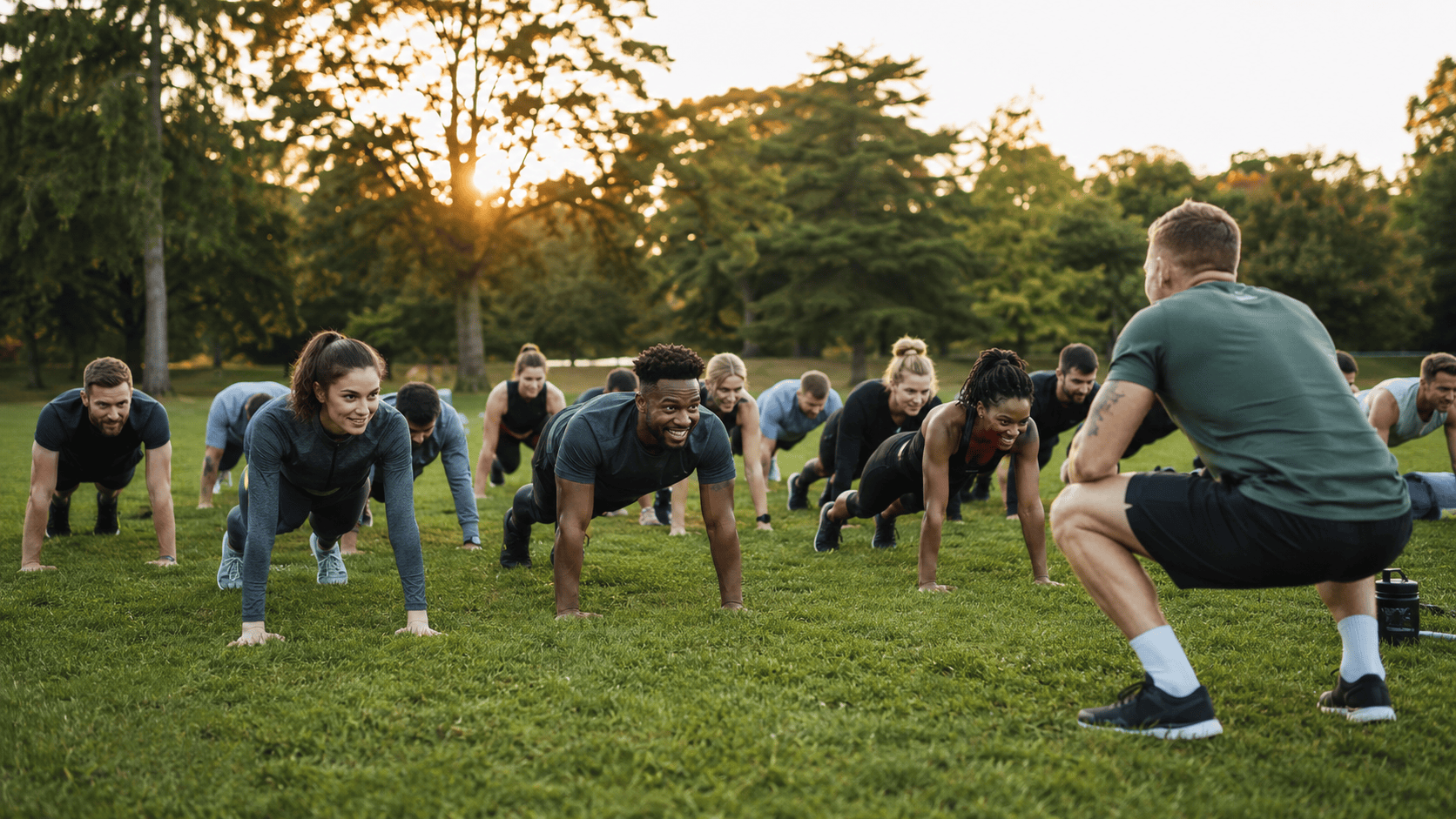
    Walk up to your local park on a cold Tuesday morning and you’ll see them — a group of people in waterproofs, someone barking encouragement, and a circuit that looks equal parts brutal and brilliant.

    Most UK military fitness bootcamp sessions last 60 minutes and follow a familiar structure:

    • Warm-up: dynamic stretching, mobility drills, and a light jog to get the heart going
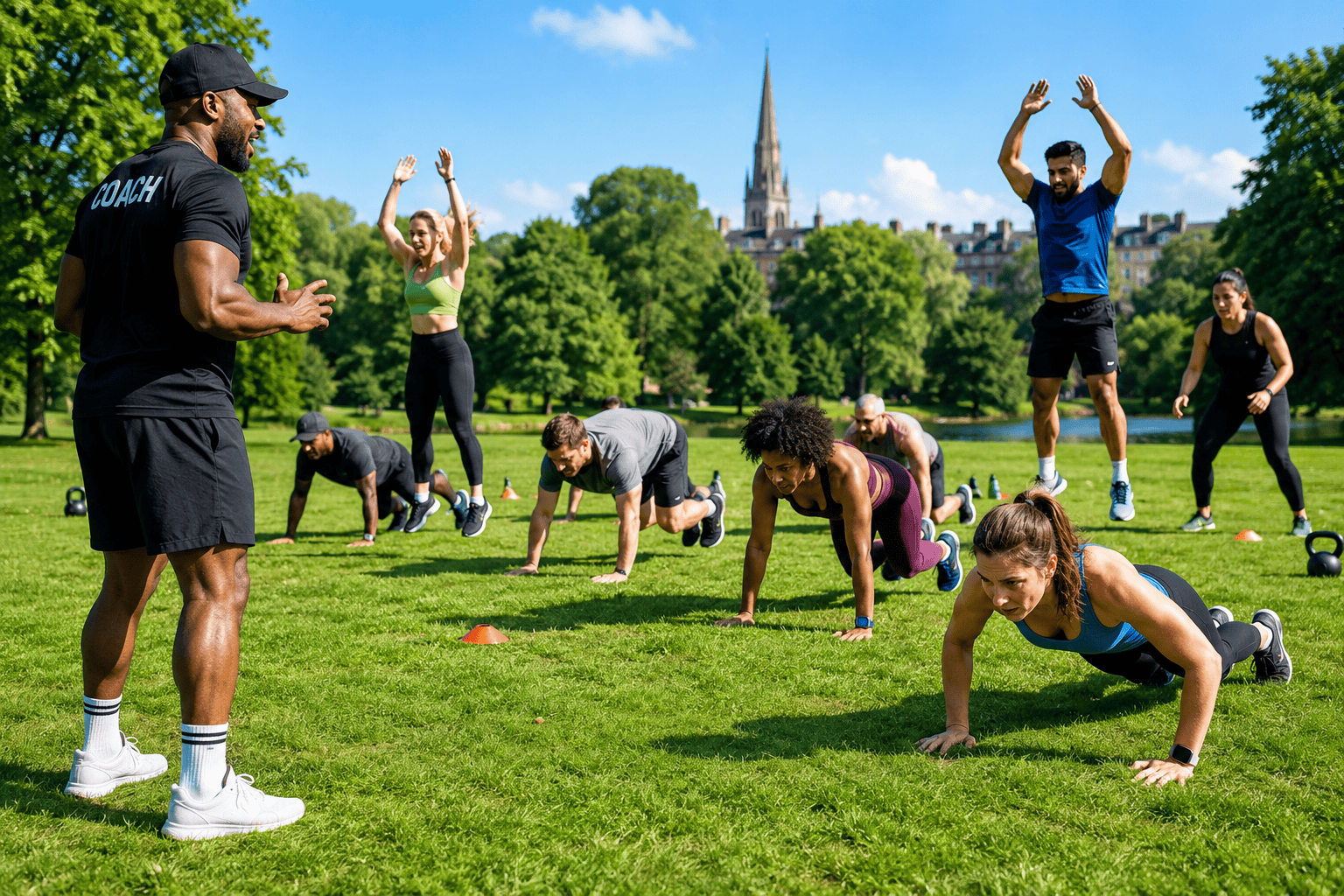
    • Cardio and strength circuits: bodyweight moves like press-ups, burpees, squats, lunges, and bear crawls, often combined with sprints, hill runs, or resistance bands
    • Partner and team exercises: carrying a mate, relay drills, or team challenges that build camaraderie
    • Cool-down: structured stretching and breathing

    Sessions at providers like British Military Fitness are led by ex-armed forces veterans and current serving military personnel. They know exactly how hard to push a group without breaking them — and they’re expert at scaling exercises so beginners aren’t left behind while regulars are still challenged.

    Some providers bring Commando Rig and FOB-style container training systems to the park for an authentically military feel. But the real currency isn’t the equipment — it’s the culture of “no one gets left behind.”

    Who Are Military Fitness Bootcamps For?

    This is the question most people ask before signing up, and the honest answer is: almost anyone.

    Complete beginners are welcome and common. Most providers split participants into fitness groups at the start — typically beginners, intermediate, and advanced. Instructors give lower-impact alternatives where needed, so your first session isn’t a humiliation exercise.

    People bored of the gym are the core demographic. If you’ve been training alone for years and hit a plateau, the accountability and structure of a group outdoor session can completely reinvigorate your fitness.

    Runners and endurance athletes find that the strength and functional movement elements fill gaps in their training — hip strength, upper body conditioning, and explosive power that pure running can’t deliver.

    People who struggle with motivation often do best in this format because the instructor and group remove any decision about whether to show up or how hard to work. You just do what you’re told, and it works.

    The one caveat: military fitness bootcamps are genuinely harder than most gym classes. You will be uncomfortable. You will be wet if it rains. The instructor will not lower the music and invite you to “find your edge at your own pace.” That’s the point — and it’s exactly why people get results.

    The Benefits Go Way Beyond Physical Fitness

    The physical benefits of military fitness training are well documented — improved cardiovascular capacity, increased muscular endurance, greater functional strength, and the afterburn effect of HIIT-style training that keeps your metabolism elevated for up to 36 hours post-session.

    But the reasons people keep coming back are usually less tangible.

    Mental toughness is the underrated benefit. Doing something hard, consistently, in bad weather, with other people who are also finding it hard — that builds genuine resilience. Learning to keep going when your body wants to stop is a transferable life skill that extends well beyond the park.

    Community is the other one. According to Sport England’s Active Lives survey, record numbers of adults in England are now physically active — but social connection remains one of the biggest drivers of long-term adherence. Military bootcamps are extraordinarily good at this. The shared suffering, the team challenges, the “same time next week” culture — it creates tight-knit groups that often extend well beyond the park.

    If you’ve been training solo and wondering why you keep falling off your programme, the camaraderie of high-intensity group training formats like HIIT is part of what makes military bootcamps so effective at keeping people consistent week after week.

    UK Military Fitness Providers Worth Knowing About

    The UK has a healthy and growing military fitness scene. Here are the main players:

    British Military Fitness (BMF)
    The big one. Over 140 venues across the UK, from Hyde Park in London to Roundhay Park in Leeds and Sefton Park in Liverpool. Classes run early mornings, evenings, and weekends. BMF is the closest you’ll get to a national chain in outdoor military fitness — well-structured, well-led, and consistent in quality.

    Be Military Fit
    Same DNA, evolved format. Be Military Fit runs group sessions in parks with ex-forces instructors and offers a structured progression system for those who want to track their fitness improvements over time.

    UK Military Fitness
    Focuses on the North of England with a strong presence in Yorkshire and Lancashire. Smaller and more community-driven than BMF, with loyal regulars who’ve been training together for years.

    Leading Military Fitness (Cheshire)
    One of the best regional providers — particularly popular across Macclesfield, Knutsford, and Wilmslow. Ideal for those in the north-west who want professionally run sessions without travelling into Manchester city centre.

    NOVA Bootcamp (Cambridge)
    A fitness-focused variation with military structure, popular with the Cambridge university crowd and local professionals after a tough morning session.

    The Commando Temple (London)
    For those who want the maximum level of challenge, the Commando Temple in New Cross offers military-style training that tips into elite territory. This is not a beginner venue — but for experienced athletes wanting something genuinely brutal, it’s unique in the UK.

    What Does a Military Fitness Bootcamp Cost?

    Costs vary by provider, but here’s a rough picture:

    • British Military Fitness / Be Military Fit: approx. £35–£55/month for unlimited sessions
    • Regional providers: £25–£45/month, or pay-as-you-go at £8–£12 per session
    • Intro offers: many providers offer a 10-session trial for £10–£20 — worth doing before committing to a monthly membership

    Compare that to a premium gym membership at £50–£90/month for a facility you use alone, and military bootcamps start looking like excellent value — especially when you factor in the coaching and accountability you’d normally pay a personal trainer in the UK to provide on a one-to-one basis.

    Most sessions are held outdoors, so you’re not paying for a building — that keeps overheads (and prices) lower than traditional gyms or indoor fitness studios.

    Military Fitness vs CrossFit vs Regular Gym

    People often compare military fitness bootcamps to CrossFit, and there are genuine similarities — both are high-intensity, functional, community-driven, and led by coaches rather than left to self-direction. The main differences come down to setting, cost, and focus.

    CrossFit centres on Olympic lifting, gymnastics skills, and competitive scoring — it’s indoors, equipment-heavy, and typically costs £60–£120/month. Military fitness bootcamps live outdoors, use minimal equipment (mainly bodyweight and resistance bands), and prioritise endurance and team spirit over personal records and scoreboards. If CrossFit’s structured strength and skill progressions appeal, it’s a brilliant format — but for raw outdoor graft and military camaraderie, bootcamps win.

    Traditional gyms offer freedom and equipment variety, but almost no structure, coaching, or accountability. For people who need to be pushed, military bootcamps deliver what a gym membership can’t.

    What to Wear and Bring to Your First Session

    First-timers often make the mistake of turning up in standard gym kit. Military fitness bootcamps are outdoor sessions — prepare accordingly.

    Essential kit:

    • Moisture-wicking base layer
    • Waterproof jacket — it will rain, this is the UK
    • Trainers with decent grip: trail runners or cross-trainers beat flat gym shoes
    • Water bottle (750ml minimum)
    • Gloves in winter months

    Leave at home:

    • Headphones — you need to hear the instructor
    • White trainers you care about
    • Any expectation of staying clean and dry

    Arrive 10 minutes early for your first session, introduce yourself to the instructor, and they’ll put you in the right fitness group. Nobody expects a new starter to keep up with the regulars — you’re there to begin, not to impress.

    How to Find Military Fitness Bootcamps Near You

    The easiest way to find military fitness and bootcamp classes in your area is through GymPal’s bootcamp listings — search by location to see verified bootcamp and military fitness providers near you, with details on session times and what to expect.

    GymPal lists over 47 bootcamp venues across the UK, from independent park-based providers to national chains like BMF. Whether you’re in Sheffield, Bristol, Norwich, or Inverness, there are sessions closer than you think — and far more of them than most people realise.

    The Bottom Line

    Military fitness bootcamps are one of the most effective, affordable, and community-driven ways to get fit in the UK. They’re demanding — genuinely so — but they’re also welcoming, progressive, and built around the kind of accountability that makes the difference between someone who trains occasionally and someone who actually transforms their fitness.

    Whether you want to break a plateau, build endurance, lose weight, or just do something that makes you feel properly alive at 6:30am on a Wednesday morning — there’s a military fitness class in your nearest park waiting for you.

    Find your local bootcamp sessions at GymPal — the UK’s fitness venue finder, covering military fitness and bootcamp classes nationwide.
  • Spin Classes UK: What to Expect at Your First Indoor Cycling Session

    Spin Classes UK: What to Expect at Your First Indoor Cycling Session

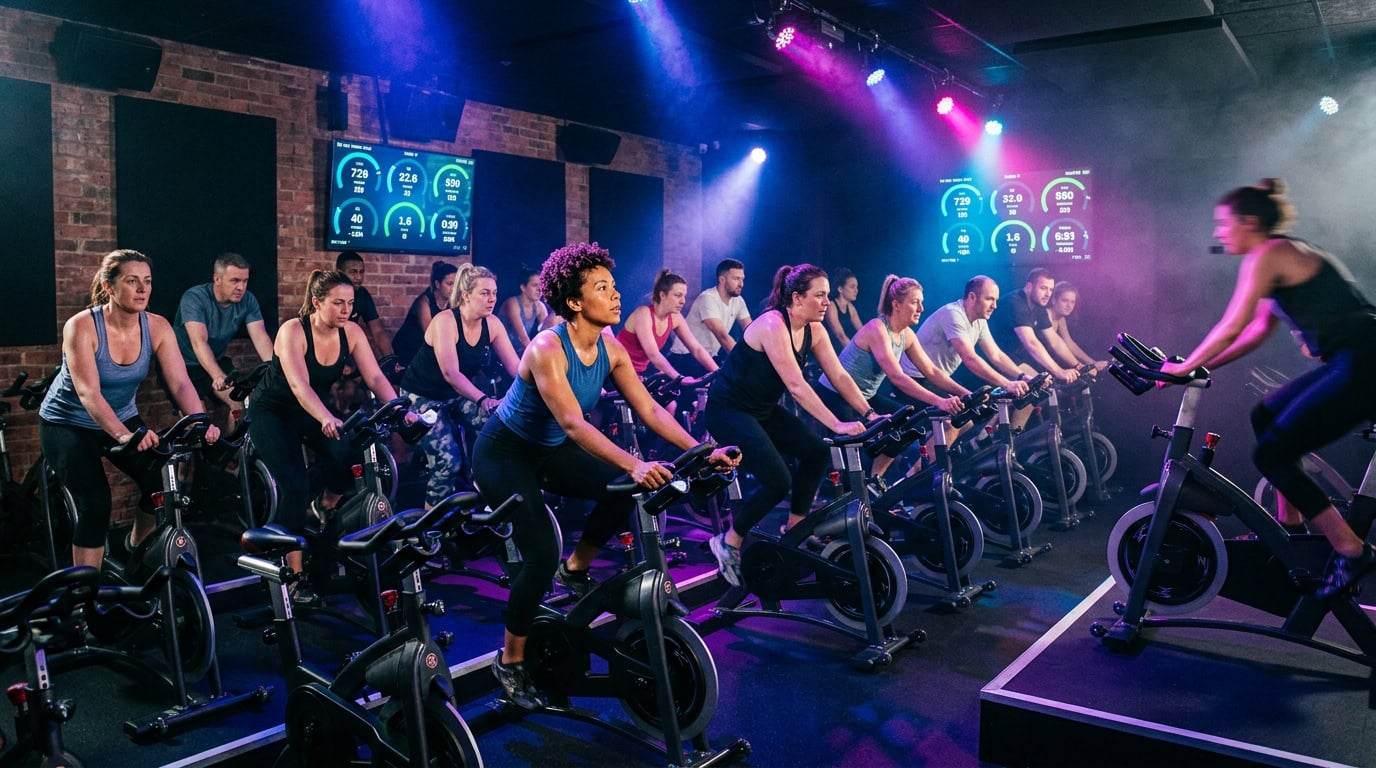
    Indoor cycling is everywhere. Walk through any mid-to-large gym in the UK and you’ll likely spot the spin studio — a darkened room of stationary bikes, bass-heavy playlists thumping through the walls, and a class of red-faced cyclists pushing hard. From council leisure centres in Sheffield to boutique studios in Shoreditch, spin has embedded itself firmly into UK fitness culture.

    But if you’ve never clipped in before, the whole thing can feel a bit intimidating. What do you wear? How do you set the bike up? Will the instructor humiliate you for not keeping up?

    The good news: spin is one of the most beginner-friendly group fitness formats going. Here’s everything you need to know before you ride.

    What Is a Spin Class?

    Spin — also called indoor cycling or studio cycling — is a group workout on stationary bikes, led by an instructor who guides you through intervals of varying intensity, all set to music. The instructor sits on a bike at the front and calls out changes: “turn it up two clicks,” “out of the saddle,” “ease off and recover.” You follow their lead, adjusting your own resistance.

    The beauty of it is that no one can see what resistance you’ve got dialled in. If you need to ease off, you ease off. It’s one of the only group fitness formats where you’re genuinely competing only with yourself.

    A standard class runs 45–60 minutes. Some gyms offer express 30-minute formats too. Most follow a rough structure:

    • Warm-up (5 minutes): low resistance, steady cadence, settling onto the saddle and loosening up your legs
    • Main set (30–40 minutes): alternating between hard efforts — sprints, climbs, out-of-saddle intervals — and recovery phases
    • Cool-down (5 minutes): low resistance, bring your heart rate down, light stretch

    Why Spin? The Benefits Are Genuinely Impressive

    Spin delivers serious cardiovascular fitness in a time-efficient package. A 45-minute session can burn anywhere between 400 and 600 calories depending on your body weight and how hard you push — comparable to a full outdoor cycling session without the hills, punctures, or lorries.

    But spin isn’t just a calorie-burner. The varied intensity builds genuine aerobic and anaerobic fitness, which pays dividends across every other workout you do. Standing intervals and hill climbs build quad, hamstring, and glute strength. And because it’s a low-impact format — your weight is supported by the saddle and pedals rather than your knees and ankles — it’s accessible to people returning from injury, those with joint problems, or anyone who finds running hard on their body.

    There’s also the communal energy. There’s something about a darkened room, loud music, and twenty people all grinding through the same effort that pushes you harder than you’d go alone. Research consistently shows that people work harder in group exercise settings — spin takes full advantage of that effect.

    Setting Up Your Bike: Get This Right Before the Class Starts

    Arrive 10–15 minutes before your first class. Book your spot in advance — most gym spin studios fill up fast, particularly the early morning and lunchtime slots.

    When you arrive, tell the instructor it’s your first time. They’ll walk you through the setup, but knowing the basics helps:

    • Seat height: Stand next to the bike. Set the saddle level with your hip bone. When pedalling, your leg should have a slight bend at the bottom of the stroke — not fully straight, not excessively bent.
    • Seat position (fore/aft): Slide the saddle forward or back so that when the pedal is at the 3 o’clock position, your knee sits directly over the pedal axle.
    • Handlebar height: Higher handlebars are more comfortable for beginners. As you get more confident, you can lower them for a more aggressive position. Start at seat height or just above.

    Most studio bikes in the UK use SPD-compatible clip-in pedals or cage pedals (flat platforms with a strap). Some boutique studios rent cycling shoes — worth asking when you book.

    What Happens During the Class

    The first five minutes feel slightly awkward. Your legs won’t feel quite right, the saddle will seem odd, and you’ll probably wonder what you’re doing. Push through it. By the ten-minute mark you’ll have found your rhythm.

    The instructor will call out resistance levels and cadence targets throughout the class. These are guides, not instructions. If they say “add four turns of resistance” and you can only manage two, that’s completely fine. The most important thing in your first session is staying in control and not burning out in the first fifteen minutes.

    Out-of-saddle work — standing climbs where you rise off the bike and pedal upright — is a staple of spin. They’re harder than they look for beginners. If you find them tough, simply stay seated and reduce the resistance slightly. No one will notice. The experienced riders in the room were beginners once too.

    Many people who get hooked on spin also incorporate other high-intensity group formats into their week. HIIT classes pair brilliantly with spin — HIIT delivers upper body and full-body conditioning while spin handles the pure cardiovascular work, so the two complement each other without much overlap.

    What Will Hurt (and How Long It Lasts)

    Your backside will ache. This is the universal spin beginner experience. The sit bones simply aren’t used to saddle pressure, and no amount of being warned about it fully prepares you. The soreness typically peaks 24–48 hours after your first session and fades significantly after three or four rides. Padded cycling shorts help enormously — they’re available from £15–£40 at Decathlon, Wiggle, or most sports retailers.

    Quad and glute DOMS. Expect delayed onset muscle soreness in your quads and glutes after your first session. Light movement the following day — a walk, a gentle swim — helps flush it through faster than complete rest.

    What won’t hurt: your joints. One of the reasons spin has such broad appeal across different age groups in the UK is that it doesn’t load your knees, hips, or ankles the way running and high-impact formats do. If you’re managing a joint issue or returning from injury, indoor cycling is one of the safest cardiovascular options available.

    What to Wear and Bring

    Keep it simple for your first session:

    • Fitted, moisture-wicking leggings or cycling shorts (avoid very loose shorts — fabric can catch on the saddle)
    • Lightweight T-shirt or vest
    • Trainers with a firm sole, or cycling shoes if you have them
    • A large water bottle — you’ll sweat more than you expect
    • A small towel

    Where to Find Spin Classes Near You in the UK

    Spin is available at every level of the UK gym market:

    Budget gyms: PureGym, The Gym Group, and Anytime Fitness all run regular studio cycling classes included in membership at no extra cost. A solid starting point if you want to try before committing to anything more expensive.

    Mid-range clubs: David Lloyd, Nuffield Health, and Bannatyne clubs typically run branded formats like Les Mills RPM. Good production quality, experienced instructors, and a solid regular class schedule.

    Boutique studios: Cities like London, Manchester, Edinburgh, and Birmingham have dedicated spin studios — think Psycle, 1Rebel, or local independents — where the entire offering centres on indoor cycling. Classes typically cost £15–£25, but the lighting rigs, sound systems, and specialist instructors are a level above the standard gym format.

    Council leisure centres: Often the most affordable option, with spin classes from as little as £5–£7 per session or included in leisure membership. Worth checking your local council’s active leisure website.

    Use GymPal to search for gyms near you with studio cycling — filter by location and group fitness to see what’s available in your area.

    How Spin Compares to Other Popular UK Group Fitness Classes

    Spin is cardiovascular-first, lower body-focused, and low-impact. Here’s how it stacks up against formats you might be weighing it up against:

    • vs HIIT: HIIT classes are typically more full-body and include bodyweight strength work. Spin is purer cardio and easier on your joints. Many regulars do both through the week.
    • vs boxing: Boxing fitness classes in the UK build upper body conditioning and coordination that spin simply doesn’t — combine the two for a well-rounded training week.
    • vs yoga/Pilates: These are complementary, not competitive. The flexibility and core strength from yoga or Pilates actually improves your spin form, especially on longer sessions.

    Your Most Common Spin Questions Answered

    Do I need to be fit to start? No. Resistance is fully in your control — dial it down and the class still works. Most UK spin instructors are experienced at welcoming complete beginners.

    How often should I go? Once a week is a great starting point. Many regulars build to two or three sessions per week once the saddle soreness has resolved and they’ve found their rhythm.

    Is spin good for weight loss? Combined with a balanced diet, yes — the calorie burn is substantial and the format is sustainable long-term because it’s low-impact and enjoyable. NHS physical activity guidelines recommend 150 minutes of moderate aerobic activity per week for adults — a couple of spin sessions covers this comfortably.

    I’m nervous about walking into a spin class for the first time. Completely normal. The gym anxiety that many UK gym-goers feel in group fitness settings is real — but spin’s dim lighting and individual resistance control make it one of the least intimidating formats available. Tell the instructor it’s your first time and they’ll look after you.

    Ready to Ride?

    Spin is one of those formats where the barrier to entry — that first slightly awkward class — gives way very quickly to a genuinely addictive workout. The calorie burn is real, the fitness gains stack fast, and the format suits almost every fitness level.

    Find a gym with studio cycling near you on GymPal — search by location, check the class timetable, and book that first ride. The saddle soreness is temporary. The fitness gains are not.

  • Strength Training for Women UK: Why Lifting Weights Is the Best Thing You Can Do for Your Health

    Strength Training for Women UK: Why Lifting Weights Is the Best Thing You Can Do for Your Health

    There’s a quiet revolution happening on the weight room floor. Walk into any decent gym in the UK right now and you’ll see women deadlifting, squatting, pressing — not apologetically tucked into a corner, but owning the space. The days of women being steered towards the treadmill and the little pink dumbbells are, thankfully, numbered.

    And it’s about time. Because the evidence for strength training — actual, progressive, load-bearing resistance work — is stacked high, and it’s especially compelling for women. If you’ve been hovering at the edge of the weights section, unsure whether it’s for you, this guide is here to settle the question.

    We’ll break down what strength training does to your body, bust the biggest myths, and give you a practical roadmap for getting started at a gym near you.

    What Strength Training Actually Does to Your Body

    Let’s start with the basics. Strength training — also called resistance training or weight training — is any exercise that makes your muscles work against an external resistance. That might be free weights, barbells, cable machines, resistance bands, or your own bodyweight.

    When you lift something challenging, you create micro-tears in your muscle fibres. Your body repairs these tears and builds the muscle back slightly stronger. Repeat this over weeks and months, gradually increasing the load, and you get meaningfully stronger, more muscular, and more physically capable.

    The process also triggers significant hormonal and metabolic responses. Your resting metabolic rate increases, meaning you burn more calories even at rest. Insulin sensitivity improves. Blood glucose regulation gets better. Inflammatory markers typically decrease with consistent training. And your bones? They respond to mechanical load by becoming denser — which matters enormously for women, as we’ll get to shortly.

    The Biggest Myth: Will You Get Bulky?

    You’ve heard it. Maybe you’ve said it yourself: “I don’t want to get too bulky.”

    Here’s the truth: for the vast majority of women, adding significant muscle mass is extraordinarily difficult. Women produce roughly 10 to 20 times less testosterone than men, and testosterone is the primary hormonal driver of muscle hypertrophy. Building the kind of visible, substantial muscle that the word “bulky” conjures requires years of dedicated structured training, very high caloric intake, and often pharmaceutical assistance.

    What strength training will do is give you a leaner, more defined physique. The women who look “toned” — which essentially means visible muscle beneath low body fat — got there through strength training, not endless cardio. Cardio burns calories during the session. Strength training changes body composition over time by building muscle and reducing relative body fat percentage. The look most women describe when they say they want to “tone up” is produced by exactly the thing they’re nervous about: lifting heavy.

    The Health Benefits That Go Way Beyond How You Look

    Here’s where the case for strength training gets genuinely compelling — particularly for women in their 30s, 40s, and beyond.

    Bone density is non-negotiable. Women are disproportionately affected by osteoporosis: according to NHS guidance on osteoporosis, around 1 in 2 women will experience a fracture related to the condition in their lifetime. Bone density peaks in your late 20s and begins to decline after 35, with the sharpest drop occurring at menopause when oestrogen levels fall. Resistance training is one of the few interventions proven to stimulate new bone formation and slow this decline — the mechanical load you place on your skeleton sends signals that prompt bone-building cells to get to work. Cardio simply doesn’t produce the same effect.

    Mental health benefits are real and substantial. Multiple studies have found strength training effective in reducing symptoms of depression and anxiety — sometimes as effective as medication for mild-to-moderate cases. There’s something grounding about the discipline of lifting: the focus it demands, the measurable progress, the growing sense of physical competence. Many women who start lifting describe it as the most reliably mood-boosting thing in their week.

    Your metabolism gets a significant, lasting upgrade. Muscle is metabolically active tissue — it burns energy just to maintain itself. The more muscle you carry, the higher your resting metabolic rate. A woman who has been lifting consistently for two years will burn meaningfully more calories at rest than before she started, even if her weight hasn’t changed. This matters enormously for long-term weight management and for the natural metabolic slowdown that comes with age.

    Strength training improves how you move in everyday life. Picking up children, carrying shopping, climbing stairs without your knees protesting — all of this is underpinned by functional strength. If you’re drawn to the idea of training that translates directly to real life, functional fitness gyms across the UK build programmes around exactly the same fundamental movement patterns — hinge, squat, push, pull — that underpin quality strength training.

    It’s especially powerful during perimenopause and beyond. As hormone levels shift in your 40s and 50s, many women find cardio-only approaches stop delivering in the way they used to. Resistance training helps preserve muscle mass (which drops sharply post-menopause), supports bone density, improves sleep quality, and helps manage body composition changes. It’s arguably the single most valuable health tool available to women over 45.

    How to Start Strength Training in the UK

    You don’t need a complicated programme on day one. Here’s a practical framework.

    Start with the fundamental movements. The foundations of strength training are five patterns: squat, hinge (like a deadlift), horizontal push (bench press or push-up), horizontal pull (barbell or dumbbell row), and vertical pull (lat pulldown). If you can perform serviceable versions of these, you have everything you need for a complete full-body programme.

    Use your gym induction. Most UK gyms include a free induction session when you join. Use it properly — ask the trainer to walk you through the key movements with light weight and give you form feedback. If you want more structured coaching, investing in even a handful of sessions with a personal trainer who specialises in strength training can compress months of trial and error into a few focused hours.

    Follow a beginner programme. A three-day-per-week full-body programme is ideal when starting out. This gives you enough frequency to build movement patterns quickly while allowing adequate recovery. Look for beginner-friendly structures like StrongLifts 5×5, GZCLP, or Starting Strength — all built around progressive overload, which is the engine of strength progress.

    Eat to support your training. You cannot build muscle in a sustained caloric deficit. If you’re eating very little, your body won’t have the raw material to repair and grow muscle tissue. You don’t need to eat dramatically more, but consuming sufficient protein — around 1.6–2g per kg of bodyweight per day — is genuinely important. This is the most commonly neglected piece of women’s strength training advice.

    Track your progress. Keep a simple training log — even in your phone’s notes app. Record exercises, sets, reps, and weights. Seeing your numbers go up week on week is one of the most motivating aspects of strength training, and it stops you drifting through sessions without purpose.

    What to Look for in a Gym for Strength Training

    Not all gyms are equally suited to lifting. Here’s what actually matters when choosing somewhere to train.

    Free weights are essential. If a gym only has resistance machines and a dumbbell rack topping out at 15kg, you’ll hit a ceiling quickly. Look for: a squat rack or power rack, a full barbell setup, a comprehensive dumbbell range (ideally to 40kg or beyond), and a deadlift platform if possible.

    Atmosphere matters enormously. The best gyms for female lifters are welcoming, not territorial. Before committing to a membership, visit and observe the weights area. Is it a mixed crowd? Do women seem comfortable lifting there? If the floor feels dominated by men guarding the squat racks, trust your instincts and look elsewhere.

    Consider a women-only environment. If gym intimidation is a genuine barrier, women-only gyms across the UK offer an excellent environment for building confidence with weights without the social dynamics of a mixed space. Many have strong free weights sections and female coaches who understand the specific physiological and psychological needs of women training for strength.

    Finding the right gym is much easier with GymPal’s UK gym search, which lets you filter by location, gym type, and facilities — so you can find a strength-friendly gym or women’s fitness space near you without trawling through pages of Google results.

    A Beginner Training Week: What It Looks Like in Practice

    For beginners, three full-body sessions per week — Monday, Wednesday, Friday — is the sweet spot. Here’s a simple alternating structure:

    Session A
    Barbell squat: 3 sets × 5 reps
    Bench press or dumbbell press: 3 × 5
    Barbell or dumbbell row: 3 × 5
    Accessory: Romanian deadlift 3 × 10, plank 3 × 30 seconds

    Session B
    Barbell squat: 3 × 5
    Overhead press: 3 × 5
    Deadlift: 1 × 5 (heavier single working set)
    Accessory: Dumbbell reverse lunges 3 × 10, lat pulldown 3 × 10

    Alternate A and B each session. Add 2.5kg to upper body lifts and 5kg to squats and deadlifts each time you complete all your reps with good form. When you can’t hit the target reps at a given weight, drop back 10% and rebuild. This simple progressive overload model drives rapid strength gains through the first six to twelve months of training.

    Rest days between sessions are non-negotiable. Muscle grows during recovery, not during the workout itself. Trying to train every day as a beginner will slow your progress, not speed it up.

    The Bottom Line

    Women and weights go together brilliantly. The science is clear, the results are real, and the fitness culture in the UK is changing fast — you’ll see it in the queues for the squat rack in any well-equipped gym. Whether you’re 25 or 65, whether your goal is to feel stronger, manage your weight, protect your bones, improve your mental health, or simply feel genuinely capable in your own body, strength training is worth starting.

    Find a gym with good free weights, learn the basic movement patterns, follow a structured programme, and eat enough protein. That’s really all it takes to get going — everything else is details you’ll figure out along the way.

    Ready to find a gym that’s right for you? Search GymPal to discover strength-friendly gyms and women’s fitness spaces across the UK — filter by your area and find somewhere you’ll genuinely want to train.

  • Pilates for Beginners UK: What to Expect, What It Costs, and How to Get Started

    Pilates for Beginners UK: What to Expect, What It Costs, and How to Get Started

    Pilates has gone from quietly niche to absolutely everywhere. You can't scroll through Instagram, walk past a leisure centre, or chat with colleagues on a Monday morning without someone mentioning it. And unlike most fitness trends, this one has substance behind the buzz.

    But if you've never tried it, starting can feel more daunting than it should. Which type of Pilates? Which studio? What do you even wear? This guide cuts through the noise and gives you everything you need to walk confidently into your first session.

    Whether you're recovering from an injury, trying to build a stronger core, or simply tired of pounding the treadmill, Pilates might be exactly what your body has been waiting for.

    Why Pilates Is Everywhere Right Now (and Whether the Hype Is Real)

    There are now over 1,980 verified Pilates studios across 117 UK cities, according to the State of UK Pilates 2026 industry report — a number that has grown year on year as demand has consistently outpaced supply. Monthly Google searches for 'Pilates near me' have risen 22% year on year, and reformer Pilates searches have surged 49% in the same period.

    The reasons aren't complicated. Pilates works. It builds genuine core strength without hammering your joints, improves posture that modern desk-based life has destroyed, and leaves you feeling taller and more mobile rather than wrecked and exhausted. It suits every fitness level — from someone who hasn't exercised in years to elite athletes using it as a recovery tool.

    The community aspect has also played a role. Pilates studios have done a better job than most gyms of creating welcoming, non-intimidating spaces where newcomers don't feel judged. The class structure is forgiving, instructors typically offer modifications for every exercise, and no one is racing anyone.

    So yes, the hype is real. And the good news for beginners is that the UK has never had more affordable, accessible options for getting started.

    Mat Pilates vs Reformer Pilates: Where Should You Start?

    This is the question most beginners get stuck on. The honest answer: start with mat Pilates, unless cost isn't a concern and you're particularly drawn to the reformer.

    Mat Pilates is performed on the floor using your bodyweight, a mat, and occasionally small props like resistance bands, Pilates rings, or small balls. It's the original form of the practice, teaches you the foundational principles — breathing, neutral spine, core activation — and is available in leisure centres, community halls, gyms, and dedicated studios across the country. Classes often cost £8–£15, making it by far the more accessible entry point.

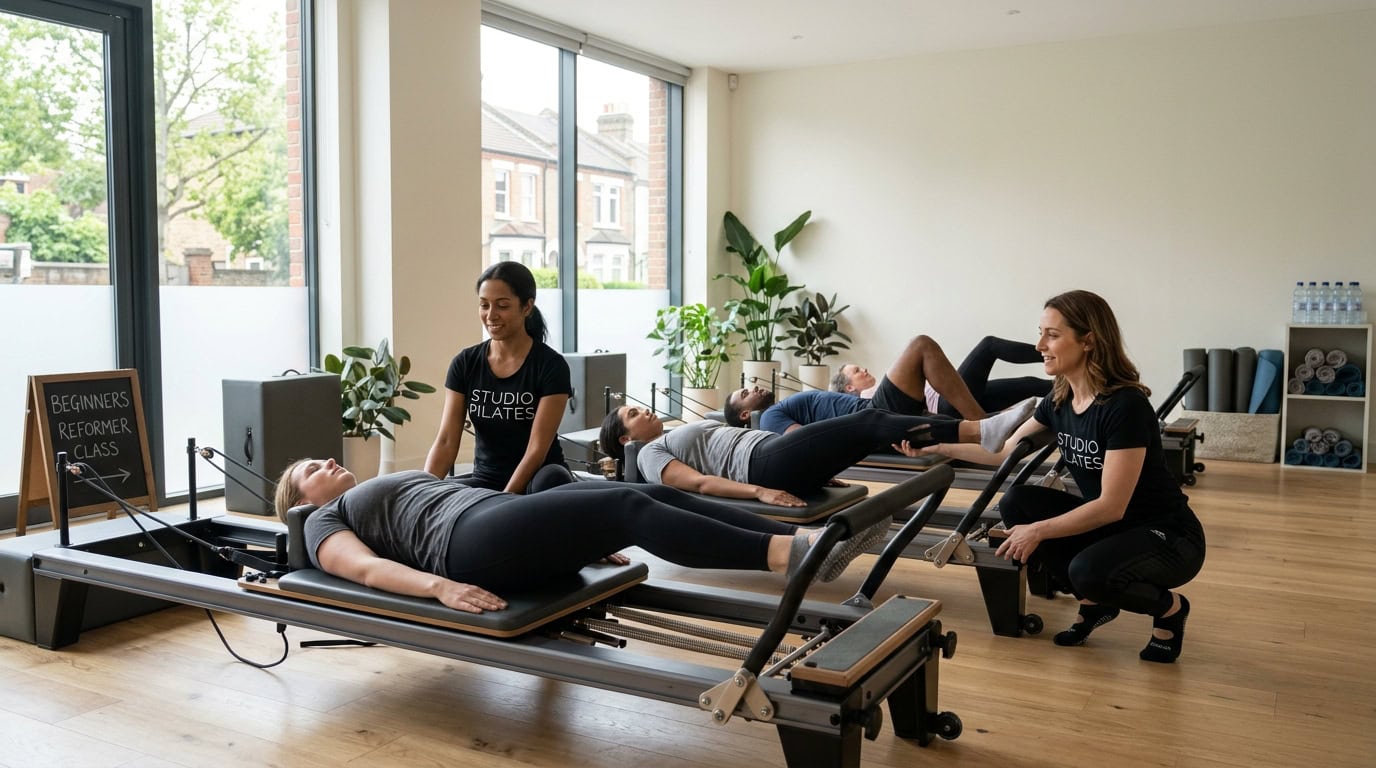
    Reformer Pilates uses a spring-loaded sliding carriage with a system of straps and pulleys. It adds resistance and instability that can make exercises both more challenging and more supportive, and it's particularly useful for rehabilitation. The reformer has its own premium price point — typically £20–£45 per class — but reformer Pilates has a steeper learning curve too, which is why most instructors recommend building your mat foundations first. Once you understand how to engage your core, breathe with the movement, and follow the basic vocabulary of exercises, you'll get far more out of the reformer than someone walking in cold.

    What Happens at Your First Pilates Class?

    Knowing what to expect is half the battle. The format varies slightly between studios, but a typical beginner mat Pilates class looks something like this:

    The warm-up (5–10 minutes)
    You'll usually start with gentle breathing exercises and mobilisation work — rolling down through the spine, opening the shoulders, activating the deep abdominals. Don't underestimate this section; it's where you start to understand the principles that underpin everything else.

    The main sequence (30–40 minutes)
    Exercises like the hundred, single leg stretch, rolling like a ball, and spine stretch are Pilates classics you'll encounter in your first sessions. The instructor will cue alignment and breathing throughout. Expect modifications to be offered constantly — beginners take the easier variation, and that's not just acceptable, it's actively encouraged.

    The cool-down (10 minutes)
    A slower sequence of stretches, often including a child's pose or supine twist, rounds things off. You should leave feeling lighter, calmer, and standing about an inch taller. If you're stiff after your first couple of sessions, that's normal — you've woken up muscles that haven't had much attention.

    One thing worth knowing: Pilates studios are consistently among the most welcoming spaces in UK fitness. If you've been putting things off because of the self-consciousness that comes with walking into a new class, it's worth knowing that the gym anxiety that plagues so many people in traditional gym settings tends to be far less pronounced in Pilates environments — classes are deliberately small, instructors introduce themselves to newcomers, and the atmosphere is quiet and focused rather than loud and performative.

    Always tell the instructor before class if you have any injuries or health conditions. Good Pilates instructors take this seriously and will give you appropriate modifications throughout.

    What to Wear and Bring

    Pilates kit is genuinely simple. Here's what you actually need:

    Clothing: Close-fitting but comfortable. Leggings and a fitted t-shirt or vest are ideal — baggy clothing makes it harder to see your alignment, and the instructor needs to be able to cue your positioning. Avoid anything with a drawstring at the back that might dig in when you're lying down.

    Grip socks: Most studios now require these. They give you traction on the mat, which matters more than you'd expect once you're doing footwork on the reformer or anything involving lateral movement. Expect to pay £8–£15 on-site if you don't have a pair — or bring your own from Amazon or a sports shop. Some studios lend them for your first visit; worth asking when you book.

    Water: Bring a bottle. Classes aren't typically sweaty enough to leave you dehydrated, but you'll want something to sip.

    Mat: Most studios provide mats, so you don't need to buy one for your first session. If you fall in love with Pilates and plan to attend regularly, a good-quality 6mm non-slip mat is worth buying eventually — they run from £20–£60 and make a noticeable difference to comfort on harder studio floors.

    That's genuinely it. No special shoes, no expensive equipment, no dedicated wardrobe required.

    How Much Does Pilates Cost in the UK?

    This varies significantly depending on where you are in the country and what type of class you're attending. Here's a realistic breakdown:

    Community and leisure centre classes: Often the best value in the country. Local councils and leisure trusts frequently run mat Pilates for £5–£10 per session in small, friendly groups taught by qualified instructors. Check your local leisure centre timetable or council leisure programme — this is a seriously underrated route for beginners.

    Gym classes included in membership: If you're already a gym member, there's a decent chance Pilates is on the timetable at no extra cost. PureGym, Nuffield Health, Bannatyne, and many independent gyms include mat Pilates as part of their classes offering. Worth checking before paying for a separate studio.

    Dedicated Pilates studios: Group mat classes typically run from £12–£20 outside London, with London drop-in prices ranging from £18–£28. Reformer classes cost more — £15–£26 in regional cities, up to £32–£45 in central London. Most studios offer a discounted introductory deal: a first class at half price, or a three-session beginner pack. This is by far the best way to trial a studio before committing to a monthly membership.

    Monthly memberships: Unlimited studio memberships generally run from £50–£90 outside London and £80–£150 in major cities. These make sense if you're attending three or more times a week, but for beginners building a habit, a class pack is often smarter until you know how often you'll actually go.

    Online Pilates: Platforms like Pilates Anytime offer unlimited access for £10–£20 per month. Excellent for home practice, though nothing replaces in-person instruction for learning the fundamentals properly.

    Is Pilates Actually a Proper Workout?

    This is the question that holds a lot of people back — especially those who associate real exercise with being out of breath and dripping in sweat. The short answer: it depends on the class, and your definition of a workout.

    A beginner mat Pilates class is not a cardiovascular workout. If elevated heart rate and calorie burn are your primary goals, you'll need to pair Pilates with something else — and there's nothing wrong with that. A lot of people run HIIT classes two or three times a week alongside Pilates, getting cardio and conditioning from the high-intensity work while using Pilates for mobility, core strength, and recovery. The two complement each other well.

    But Pilates is absolutely a legitimate strength and conditioning workout. After a month of consistent attendance, most beginners notice measurable improvements in posture, flexibility, balance, and the kind of functional strength that makes everyday life easier. People with desk jobs frequently report that persistent back pain decreases significantly. Runners use Pilates to correct the muscle imbalances that cause injury. Older adults use it to maintain mobility and range of motion.

    The misconception that it's too gentle comes from comparing it to the wrong things. Compare it to yoga, and it's more active. Compare it to CrossFit, and it's lower intensity. Compare it to doing nothing, and for a large number of people it's genuinely transformative.

    How to Find Pilates Classes Near You

    With nearly 2,000 dedicated studios across the UK — plus Pilates on the timetable at thousands of gyms, leisure centres, and community venues — there are more options than most people realise, even in mid-sized UK towns and cities.

    GymPal lists Pilates classes and studios across the UK, covering dedicated reformer and mat Pilates studios, gyms with included timetable classes, and leisure centres. Search for Pilates near you on GymPal to compare options in your area without trawling through multiple websites.

    When comparing studios, look for:

    • Class size: Smaller is better for beginners. A class of 8–12 people means the instructor can see what you're doing and correct you. Classes of 20+ make personalised instruction much harder.
    • Instructor qualification: Look for instructors trained through the Pilates Foundation, Body Control Pilates, or STOTT Pilates — the main recognised UK qualification pathways.
    • Introductory offer: Almost all studios offer one. Use it — it's the lowest-risk way to decide whether the studio and instructor are right for you before committing to a membership.
    • Beginner-specific classes: Where available, take these over general classes for your first few sessions. They move at a pace that lets you build the foundations properly rather than scrambling to keep up.

    Ready to Give It a Go?

    If you've been curious about Pilates but haven't yet taken the step, the barrier is lower than you think. Start with a mat class — your local leisure centre is a great first port of call — arrive in comfortable clothes with a pair of grip socks, tell the instructor you're new, and give it three or four sessions before forming a firm opinion. Most people who do that become regulars.

    Pilates isn't a miracle, and it won't replace every other form of exercise. But as a practice that genuinely improves how your body feels, moves, and copes with the demands of daily life, it earns its place at the top of UK fitness trends for good reason.

    Find your nearest class, studio, or gym offering Pilates on GymPal's UK fitness finder — and make 2026 the year you actually try it.

  • Women-Only Gyms UK: Why Female-Focused Fitness Spaces Are Growing Fast

    Women-Only Gyms UK: Why Female-Focused Fitness Spaces Are Growing Fast

    Walk into most mainstream gyms on a Monday evening and the weight room tells a familiar story: rows of blokes hogging the squat racks, unsolicited advice flying across the floor, and more than a few intimidating stares from regulars who treat the gym as their personal territory. For a lot of women in the UK, that environment is a massive turn-off — and it’s one of the biggest reasons they never make fitness a habit in the first place.

    Women-only gyms exist to flip that script entirely. No mixed-sex floor, no uninvited commentary, no pressure to look a certain way while you’re mid-burpee. Just a space where you can train on your own terms, surrounded by people who get it. And the demand for that kind of environment is absolutely booming right now.

    Whether you’ve never set foot in a gym before or you’re a seasoned lifter who’s simply had enough of the mixed-gym experience, this guide covers everything you need to know about women-only gyms across the UK — what they offer, what they cost, and where to find one near you.

    Why Women-Only Gyms Are Having a Moment

    It’s not just anecdotal. Research consistently shows that a significant number of women feel uncomfortable or unwelcome in standard gym environments. Feeling watched, feeling out of place, or simply feeling like the equipment wasn’t designed with you in mind — these are real barriers that keep women from getting started or sticking with it.

    This discomfort has a name in fitness culture: gymtimidation. It affects beginners especially, but even experienced gym-goers can find mixed environments draining. A dedicated women’s space removes those friction points completely. You can focus on your workout instead of managing your surroundings, and that makes an enormous difference to consistency over time. If gym anxiety has been holding you back from committing to a fitness routine, a female-focused environment is often the single most effective change you can make.

    Beyond comfort, there’s a growing cultural shift at play. Women’s sport and fitness have surged in visibility and credibility over the last decade — from the Lionesses to the rise of strength training on social media. More women than ever are lifting weights, doing HIIT, boxing, and taking up sports they were once told weren’t “for them.” Women-only gyms are meeting that energy with spaces built specifically to support it.

    What to Expect Inside a Women-Only Gym

    The stereotype of a women’s gym being all pink walls and light dumbbells is well and truly outdated. The best women-only facilities in the UK offer serious kit and a comprehensive class schedule — the difference is in the atmosphere, not the equipment.

    You can typically expect to find:

    • Full free weights sections — including barbells, squat racks, and kettlebells
    • Cardio equipment — treadmills, bikes, rowing machines, cross-trainers
    • Resistance machines — targeting all major muscle groups
    • Group fitness studios — yoga, Pilates, HIIT, Zumba, cycling, and more
    • Changing rooms and showers — often more spacious and better maintained than in mixed gyms
    • Personal training — from female coaches with specialist knowledge in women’s health and training

    Many women-only gyms also offer programming specifically tailored to hormonal cycles, pregnancy and postnatal fitness, and perimenopause. That level of specificity is genuinely hard to find in a mainstream gym, and it’s a major draw for members at different life stages.

    If you’re interested in the strength and conditioning side of things, many women’s gyms now offer functional fitness training — compound movements, sled work, battle ropes — in a fully female environment. The “light and toning” era is over.

    The Biggest Women-Only Gym Options in the UK

    The UK women-only gym market spans everything from small independent studios to national chains. Here’s a look at what’s available:

    Curves

    Probably the most recognised women-only gym brand globally, Curves operates dozens of clubs across the UK. Their circuit-based format — 30 minutes of combined strength and cardio on machines arranged in a circle — is designed to be accessible and time-efficient. Popular with older members and those returning to fitness after a long break. Membership typically starts at around £30–£40 per month depending on location.

    Anytime Fitness (Women-Only Locations)

    While Anytime Fitness is predominantly mixed, several UK locations operate as women-only facilities. Check individual clubs when searching, as the designation varies by site. The 24/7 access model works well for women who prefer off-peak hours.

    Independent Women’s Studios

    This is where the real variety is. Independent women’s gyms across the UK — from cities like Manchester, Leeds, Birmingham, and Bristol to smaller towns — often offer the most tailored programming and community feel. Think boutique lifting studios, women-run boxing gyms, and yoga spaces that feel genuinely inclusive. Monthly memberships range from £25 at budget-friendly independents to over £100 at premium boutique studios.

    How Much Does a Women-Only Gym Cost in the UK?

    Pricing varies enormously based on location, facilities, and the type of gym. As a general guide:

    • Budget women-only gyms: £15–£35/month — typically circuit-based or smaller independents in lower-cost areas
    • Mid-range women’s health clubs: £40–£70/month — more kit, classes included, changing room facilities
    • Premium boutique studios: £80–£150/month — small group classes, specialist coaching, high-end facilities
    • Pay-as-you-go classes: £10–£25 per session — great for trying a studio before committing

    Most women’s gyms offer a free trial or introductory session, so it’s worth taking advantage of that before signing a contract. If you’re weighing up different membership options, our UK budget gym comparison gives useful context on what different price points typically include — the benchmarks apply even when comparing against women-only options.

    Women-Only Gyms vs. Mixed Gyms: Which Is Right for You?

    Neither type is objectively better — it’s about what environment helps you show up consistently.

    Women-only gyms tend to win if:

    • You feel self-conscious or anxious in mixed environments
    • You want coaching tailored specifically to women’s health and bodies
    • You prefer a community atmosphere built around shared experience
    • You’re a beginner and want to build confidence without an audience

    Mixed gyms might suit you better if:

    • The nearest women-only option is too far away or too expensive
    • You train with a partner or friend of a different gender
    • You prefer access to more equipment or 24/7 opening hours
    • You’ve found a mixed gym with a positive, respectful culture

    The best gym is the one you’ll actually go to. Don’t let anyone tell you that preferring a single-sex environment is unnecessary — if it’s what keeps you consistent, it’s the right choice.

    What the Numbers Say About Women in UK Fitness

    According to ukactive, women now make up the majority of gym members in the UK — a shift that’s happened gradually over the past decade as the industry has moved away from a historically male-dominated culture. That demographic reality is driving serious investment in women-focused fitness spaces, and the quality of provision has improved dramatically as a result.

    Participation in strength training among women has also risen sharply, driven largely by social media and a broader cultural rejection of the idea that lifting is “not for women.” Women-only gyms are ideally placed to capitalise on this shift — they offer the environment where new lifters can build confidence without intimidation, and where experienced ones can train seriously without distraction.

    Women-Only Gyms by Region: What’s Available Across the UK

    Provision varies significantly depending on where you live. Major cities have the widest choice, but women-only options are more widely distributed than you might think.

    London has the densest concentration, with boutique studios like Kobox (women-only sessions), dedicated women’s PT studios in Shoreditch and Brixton, and several Curves locations across the boroughs. Expect to pay a premium — £60–£120/month is typical for central locations.

    Manchester and the North West have seen strong growth in female-focused fitness venues over the past five years, with women-only lifting clubs and group training studios well established across the city centre and suburbs. Several gyms cater specifically to Muslim women with private facilities.

    Birmingham has a particularly strong market for women-only gyms, with a mix of Curves franchises, independent studios, and culturally diverse options serving communities across the city. Prices here tend to be more competitive than London.

    Scotland and Wales are less well served than England in terms of sheer volume, but major cities like Glasgow, Edinburgh, and Cardiff all have credible women-only options. Rural areas will have fewer choices, which makes online resources like GymPal especially useful for tracking down what’s available locally.

    Wherever you are, the market is growing. New women-only studios have opened steadily across the UK over the past couple of years, often driven by female trainers who’ve set up on their own after careers in mixed gyms. These smaller independent venues are frequently the best quality — worth seeking out even if they’re slightly less convenient than the nearest chain.

    How to Find a Women-Only Gym Near You

    The easiest way to find women-only gyms across the UK is to search on GymPal — enter your town or postcode, filter by gym type, and browse hundreds of female-focused venues with contact details, facilities listings, and direct booking links. Whether you’re in London, Leeds, Glasgow, Cardiff, or anywhere in between, GymPal makes it easy to find and compare women’s gyms near you.

    When you find one you’re interested in, it’s worth asking a few questions before you commit:

    • Are all staff female, or are male staff ever on the gym floor?
    • What’s included in the membership — classes, PT sessions, spa access?
    • Is there a joining fee or minimum contract period?
    • What are the peak hours, and how busy does it get?
    • Do they offer any specialist programmes — postnatal, menopause, beginner lifting?

    A quick tour or free trial session will tell you more than any brochure. Most women-only gyms are genuinely welcoming to visitors — don’t be shy about popping in to see what the atmosphere is like before you sign up.

    The Verdict

    Women-only gyms are no longer a niche offering. They’re fully equipped, professionally run fitness spaces that happen to remove one of the most persistent barriers to exercise for women in the UK: feeling uncomfortable in their own training environment.

    If you’ve been putting off joining a gym because the standard mixed environment doesn’t feel right, a women-only gym might be exactly what you’ve been waiting for. The quality is there, the community is there, and with more studios opening across the country — so is the access.

    Find women-only gyms and female-friendly fitness studios near you on GymPal, and take the first step towards a training environment where you can genuinely thrive.

  • Boxing Classes UK: A Beginner’s Guide to Getting Started in the Ring

    Boxing Classes UK: A Beginner’s Guide to Getting Started in the Ring

    Boxing has never been more popular in the UK. Whether it is the explosive cardio, the stress-relief of hitting a bag, or the camaraderie of a proper boxing club, more people than ever are lacing up gloves for the first time. Around 1.2 million people in the UK now take part in some form of boxing fitness each year — and the numbers keep climbing.

    But if you have never set foot in a boxing gym, it can feel like a world unto itself. Different gyms cater to wildly different crowds, from elite fighters in training to office workers wanting to blow off steam on a Tuesday evening. The kit, the lingo, the unwritten rules — it is enough to make even a confident gym-goer pause at the door.

    This guide cuts through all of that. Here is exactly what to expect from boxing classes in the UK, what you will pay, and how to find a gym that suits you — whether you want to get fitter, learn a skill, or step into the ring yourself one day.

    Why Boxing Has Exploded as a Fitness Choice

    A decade ago, boxing as a fitness pursuit was still fairly niche. Today it is everywhere — from boutique boxing studios in Manchester and London to community boxing clubs in rural market towns across Yorkshire, the Midlands, and the South West.

    The reasons are not hard to understand. An hour of boxing burns somewhere between 500 and 700 calories, putting it up there with running and cycling for cardiovascular output. But unlike a treadmill session, boxing demands full mental engagement. You cannot zone out when you are trying to remember a jab-cross-hook combination while keeping your guard up and your feet moving.

    There is also a compelling mental health angle. The focused, repetitive nature of bag work is one of the best stress-busters going, and the discipline of learning a technical skill builds confidence that carries over into everyday life. NHS mental health services and community programmes have increasingly turned to boxing as a therapeutic tool — and for good reason.

    Types of Boxing Classes You Will Find in the UK

    One of the things that confuses newcomers is that “boxing class” can mean very different things depending on the gym. Here is a quick breakdown of what is out there:

    Fitness Boxing and Boxercise

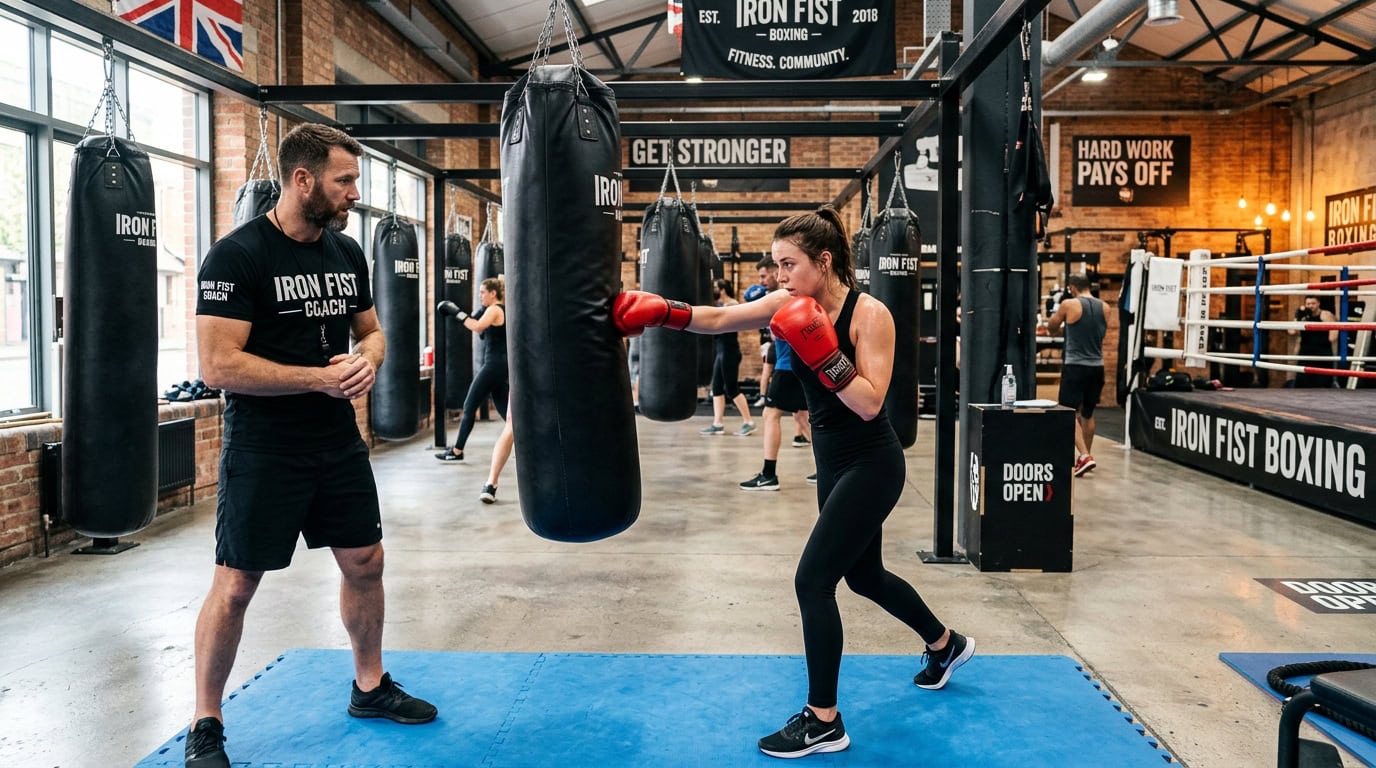
    Non-contact boxing for fitness. No sparring, no partner drills where anyone actually gets hit — just pads, bags, and combinations either choreographed to music or called out by an instructor. These sessions are brilliant for cardio and coordination, and they are run by mainstream gym chains like PureGym and Virgin Active as well as specialist studios. If you are coming to boxing primarily for the workout and have zero interest in ever sparring, this is your entry point.

    Technical Boxing Classes

    Offered by dedicated boxing clubs, technical classes teach you the actual sport: footwork, stance, guard, punch technique, head movement. These classes might eventually progress to controlled pad work with a partner, but there is no contact at beginner level. Choose these if you genuinely want to learn to box, not just get sweaty punching a bag.

    White Collar Boxing

    White collar boxing has grown massively over the last decade. It is a structured programme — usually 8 to 12 weeks — where complete beginners train towards an organised charity fight event. It is hugely popular with professionals who want a clear goal to work towards, and the events themselves are well-managed with proper safety protocols.

    Women’s Boxing Classes

    Women’s boxing has surged in popularity since Britain’s Nicola Adams became a household name. Many clubs now run women-only sessions, and some boxing gyms are almost entirely female in membership. The community at these clubs tends to be extraordinarily welcoming, making them a great option if the idea of a male-dominated gym environment puts you off.

    What Happens in Your First Boxing Class

    Most beginner boxing classes follow a similar structure, which is reassuring to know before you turn up.

    You will start with a warmup — typically skipping, some light shadow boxing in the mirror, and mobility work. Do not stress if you cannot skip to save your life; most instructors have seen every level of beginner and will not bat an eyelid.

    From there you will move into technique work: learning your stance, your guard, and the basic punches — the jab, cross, hook, and uppercut. The instructor demonstrates, then you practise, either on the bag or in front of a mirror.

    Bag rounds follow, where you string the combinations together. You will hear the timer go off in 2- or 3-minute intervals — the same format as actual boxing rounds. Work hard, then rest. Repeat. It sounds simple, and it is — until your lungs start burning at round three.

    Many classes end with conditioning work (press-ups, burpees, core exercises) before a cooldown and stretch. The whole thing is usually 45 to 60 minutes. You will be tired. You will also feel brilliant.

    If nerves are a factor — and for many people they are, stepping into any new gym environment — the gymtimidation that stops people walking through the door is something boxing clubs actually handle well. The sport has a mutual respect built into its culture that most clubs carry into how they treat newcomers. You are not an intrusion; you are exactly who the session is designed for.

    How Much Do Boxing Classes Cost in the UK?

    Costs vary significantly by location and gym type, but here is a realistic overview for 2026:

    • Fitness boxing and boxercise at mainstream gyms: Usually covered by your existing gym membership. If you are already paying £25–£45 per month at a budget gym, boxing classes are likely included at no extra cost.
    • Dedicated boxing gym membership: Expect £40–£80 per month for unlimited access, which typically includes coached sessions. Community boxing clubs — often affiliated with England Boxing — can be considerably cheaper.
    • Drop-in sessions: £10–£25 at most clubs. Boutique fitness boxing studios in London can charge £25–£35 per session.
    • White collar boxing programmes: £200–£400 for the full 8-to-12-week package. Some clubs offer it free in exchange for raising charity sponsorship.
    • One-to-one boxing coaching: £40–£80 per hour outside London; £70–£120 per hour in the capital.

    Regional variation matters too. You will pay notably more in London and the South East than in the Midlands or the North of England, where excellent community clubs often charge under £30 per month.

    What Kit Do You Actually Need?

    For your first session at most gyms, the list is short:

    • Trainers: Cross-trainers or running shoes are fine to start. Proper boxing boots are great eventually but entirely optional for beginners.
    • Comfortable workout clothes: Nothing specialist needed. A t-shirt and shorts or leggings work perfectly.
    • Hand wraps: Most gyms will lend a pair for your first session. They cost around £5–£10 to buy your own, and they protect your knuckles and wrists — worth buying once you know you enjoy it.
    • Boxing gloves: Again, most gyms lend these initially. When ready to buy, budget £30–£60 for a decent pair. Do not go cheap; gloves are there to protect your hands.
    • Gum shield: Only required once you start any contact work. Not needed for bag classes.

    Resist the urge to panic-buy expensive kit before your first session. Show up, try it, invest once you know you love it.

    Boxing vs. Other High-Intensity Fitness Classes

    A common question is how boxing stacks up against other cardio-heavy options. Boxing — done properly, in rounds — is among the most demanding cardiovascular formats you can choose. The constant movement, the upper body effort, the mental engagement: all of it drives your heart rate high and keeps it there.

    The high-intensity interval training scene in the UK achieves similar metabolic demands through structured work-rest intervals. Boxing achieves it almost by default — rounds are natural intervals. Many fitness boxing studios blend both approaches, using boxing formats to structure the session. Either way, your cardiovascular system will have to work hard. Boxing just tends to feel less like exercise while you are doing it.

    How to Find the Right Boxing Gym Near You

    The UK has no shortage of boxing gyms — from amateur clubs affiliated with England Boxing in every major town to high-end boutique studios in city centres. The challenge is finding one that suits your goals.

    Think about what you actually want. If you are after high-energy cardio with great music and no contact, a boutique fitness boxing studio is probably the right fit. If you genuinely want to learn the sport, look for a gym that trains fighters at some level — even if you never plan to spar yourself, the quality of technical coaching in these clubs is usually higher.

    According to England Boxing, the sport’s national governing body, affiliated clubs must meet structured safeguarding and coaching standards — a good indicator to look for when vetting a gym.

    If you are also weighing boxing against other combat sports, the guide to martial arts gyms across the UK covers Muay Thai, Brazilian jiu-jitsu, judo, and MMA alongside boxing — useful if you are not sure yet which discipline appeals most.

    GymPal makes it easy to search for boxing gyms and martial arts clubs near you across the UK. Filter by location, browse the listings, and get in touch with a club that sounds right. Most gyms are happy to answer questions over the phone or let you watch a session before committing.

    Is Boxing Safe for Beginners?

    For non-contact fitness boxing, absolutely — the risk profile is similar to any other gym class. For technical boxing with bags and pads, the main injury risks are to the hands, wrists, and shoulders, all of which are mitigated by proper technique and good equipment.

    Sparring is a different conversation. Reputable gyms will not put beginners into contact work until they have the technical foundations and, more importantly, the confidence and readiness to do so safely. Any club that pressures newcomers into sparring before they are ready is one to avoid.

    As with any new high-intensity exercise, a quick word with your GP first is sensible if you have existing health conditions. For most people, though, boxing is a safe and enormously rewarding addition to a fitness routine.

    Making the Most of Your First Month

    The biggest mistake new boxers make is rushing. Boxing is a technical sport, and the early weeks are about building movement patterns — how you stand, how you move, how you throw punches without injuring yourself. Resist the temptation to go harder before you have nailed the basics.

    Commit to two or three sessions per week in your first month. Your forearms and wrists will be tired in ways you did not expect — bag work is genuinely demanding on the hands — so give yourself recovery time between sessions. Most newcomers find that their cardiovascular fitness improves quickly; boxing is efficient. The technique takes longer to feel natural, and that is completely normal.

    Find a training partner if you can. Whether it is a mate who starts with you or someone you meet at the club, having someone at a similar level keeps you both accountable and makes the sessions more enjoyable. Boxing is a solo sport in the ring; in the gym, it is very much a team effort.

    Ready to Find Your Club?

    Boxing is one of those activities that people try once, are not sure about, and then find themselves completely hooked a month later. The combination of physical challenge, skill development, and genuine community is hard to replicate in other workout formats.

    Whether you are after a boxercise session to supplement your regular gym routine or you want to learn the sport properly, the UK has options at every level and price point. Use GymPal to find boxing gyms and martial arts clubs near you — browse by location, check the listings, and find a club that feels right.

    The first session is always the hardest. After that, most people cannot wait to go back.

  • Yoga Classes UK: How to Find the Right Style for You

    Yoga Classes UK: How to Find the Right Style for You

    You’ve decided you want to try yoga. Good decision. Millions of Brits are doing it — and not just the ones who travel with a rolled-up mat under their arm. From rugby players using it for recovery to office workers managing back pain, yoga has quietly become one of the most widely practised fitness activities in the UK.

    Here’s the problem: you turn up to book a class and you’re immediately faced with a bewildering menu. Hatha, Vinyasa, Yin, Ashtanga, Restorative, Power Yoga, Kundalini, Bikram… It looks like a foreign language, and picking the wrong one can leave you either bored stiff or completely out of your depth.

    This guide cuts through the confusion. We’ll explain exactly what each major yoga style involves, who it’s best suited to, and how to find quality yoga studios near you anywhere in the UK — from Birmingham and Bristol to Edinburgh and Belfast.

    How Popular Is Yoga in the UK?

    It’s more mainstream than you might think. Surveys have consistently found Hatha the most common style in the UK at around 28% of all classes, followed by Iyengar (26%) and Vinyasa (15%). According to the British Wheel of Yoga — yoga’s governing body in England — tens of thousands of instructors are now teaching across the country, with studios in virtually every market town and city.

    The boom isn’t slowing down either. Drop-in classes typically cost £10–£20, monthly studio memberships run around £80–£100, and many gyms now include yoga in their group class timetable at no extra charge. There are genuinely more ways to try yoga in the UK than ever before.

    The question isn’t whether you’ll find a class. It’s which one is actually right for you.

    The Big Three: Hatha, Vinyasa, and Yin

    These three styles between them account for the vast majority of yoga classes you’ll find in UK studios. Get comfortable with what they mean and you’ll immediately feel more confident booking your first session.

    Hatha Yoga

    Hatha is the foundation of almost everything in modern yoga. In its broad sense, the term covers any yoga that uses physical postures, but in practice a “Hatha class” in the UK typically means a slower-paced session where you hold poses for several breaths before moving on. Teachers spend time on alignment — making sure you’re doing each position safely — and classes rarely feel rushed.

    Best for: Complete beginners, anyone returning after injury, people who want a gentle introduction to the postures without feeling overwhelmed.

    Typical class: 60–75 minutes, includes warm-up, standing poses, floor work, and savasana (final relaxation).

    Vinyasa Yoga

    Vinyasa links postures together into flowing sequences synchronised with the breath. You move constantly — inhale into one pose, exhale into the next — which gives classes a more athletic, rhythmic feel. Many Vinyasa teachers play music, and the intensity can range from moderate to genuinely challenging depending on the studio.

    Best for: People who want to break a sweat, anyone who finds slow-paced exercise boring, gym regulars looking for variety.

    Typical class: 60–90 minutes. Expect to get warm quickly. The first class might feel fast — by the second or third you’ll start to find your flow.

    Yin Yoga

    Yin is the polar opposite of Vinyasa. Poses are held for 3–5 minutes at a time, sometimes longer, targeting deep connective tissue, fascia, and joints rather than the muscles. It feels almost meditative and is deliberately challenging in a different way — holding stillness requires real mental discipline.

    Best for: Athletes and gym-goers who are tight through the hips and hamstrings, anyone with high stress levels, people who struggle to switch off.

    Typical class: 60–75 minutes, low number of poses, extremely quiet atmosphere. Don’t be surprised if you fall asleep in the final pose.

    Other Styles Worth Knowing

    Beyond the big three, you’ll regularly see these on UK studio timetables:

    Ashtanga Yoga — A structured, physically demanding sequence of poses always performed in the same order. Ashtanga mysore-style classes let you work at your own pace through the sequence with one-to-one teacher guidance. Traditional and disciplined; not ideal for absolute beginners but brilliant once you have some foundation.

    Restorative Yoga — The quietest style of all. Poses are fully supported with bolsters, blankets, and blocks, and held for up to 10 minutes. The aim is complete physical release rather than stretch. Excellent for stress recovery and burnout.

    Power Yoga — A Westernised, gym-friendly version of Ashtanga that drops the rigid sequence. Think circuits with a yoga mat. High intensity, high energy, popular with people who come from a gym background.

    Kundalini Yoga — Significantly more spiritual and ritualistic than most styles. Involves chanting, breathwork, and repetitive movement. Can be brilliant for mental health but feels unfamiliar to those expecting a purely physical practice.

    Bikram / Hot Yoga — Hot yoga classes in the UK are typically held in rooms heated to 37–42°C and follow a set sequence of 26 poses. Love it or hate it, there’s rarely a middle ground — but many practitioners swear by the combination of heat and yoga for improving flexibility and releasing tension.

    How to Choose the Right Style for Your Goals

    Still not sure? Use this as a quick filter:

    You want to lose weight or build strength → Start with Vinyasa or Power Yoga. Both raise your heart rate and engage the whole body.

    You’re recovering from injury or managing chronic pain → Hatha or Restorative. Slower pace, more teacher attention to alignment, lower risk.

    You’re a regular gym-goer who ignores stretching → Yin. It will target exactly the places gym work tightens up — hips, hamstrings, thoracic spine.

    You want to reduce stress and improve sleep → Restorative, Yin, or a gentle Hatha class with a strong savasana.

    You’ve tried yoga before and found it too slow → Vinyasa, Ashtanga, or Power Yoga.

    You’re a complete beginner worried about keeping up → Book a beginner-specific Hatha class, not a general class. The difference matters. Many people who feel put off by yoga have accidentally walked into an intermediate Vinyasa session on their first try.

    If you’re generally nervous about turning up somewhere new, you’re definitely not alone — the same social anxiety that affects gym newcomers hits yoga studios too. Overcoming gym anxiety is a genuinely common challenge, and most yoga teachers are excellent at making first-timers feel welcome.

    Yoga vs. Pilates: What’s the Difference?

    This question comes up constantly. Both involve controlled movement, breathing, and floor-based work — it’s easy to see why people confuse them.

    The key difference: yoga is rooted in an ancient tradition with spiritual dimensions (though most UK classes are entirely secular and fitness-focused). Pilates was developed in the 20th century specifically to rehabilitate and strengthen the body, with a consistent emphasis on core stability and spinal alignment.

    In practical terms, yoga tends to involve more flexibility, balance, and variety in movement, while Pilates maintains a tighter focus on core strength and controlled precision. Pilates for beginners is a great complementary practice — many regular practitioners do both, and the two disciplines genuinely reinforce each other. If you enjoy one, there’s a good chance you’ll enjoy the other.

    What to Bring to Your First Yoga Class

    Keep it simple for the first few sessions:

    • Mat — Most UK studios provide them for hire (usually £1–£2). Buy your own once you know you’ll stick with it.
    • Comfortable clothing — Leggings or shorts, a fitted top. Baggy t-shirts work fine for Hatha but can be awkward in inversions.
    • Water bottle — Essential for Vinyasa and anything heated.
    • Bare feet — Yoga is always done without shoes, so a pair of socks to wear in the changing room is handy.
    • An open mind — There will be Sanskrit words you don’t recognise. Pick them up gradually; nobody expects you to know them on day one.

    Arrive 5–10 minutes early, tell the teacher it’s your first class, and mention any injuries or health conditions. Most UK teachers will adapt poses for you without making a fuss about it.

    How to Find Yoga Classes Near You in the UK

    The easiest way to find yoga classes — whether you’re in Glasgow, Cardiff, Manchester, or a market town in Suffolk — is to search by location and filter by style. GymPal lists yoga studios across the UK, so you can compare what’s available near you, check what styles are on offer, and read venue details before you commit to anything.

    Find yoga studios near you on GymPal and filter by your area. Most studios offer a first-class trial or an introductory-week pass — it’s worth trying two or three different places and styles before settling on a regular session.

    Final Thoughts

    Yoga is one of those activities that rewards curiosity. The people who get the most from it are usually the ones who try a few different styles before deciding what clicks. A single difficult Vinyasa session shouldn’t put you off any more than one bad run should stop you lacing up again.

    Start with a beginner-labelled Hatha class if you’re genuinely new. Move to Vinyasa when you want more challenge. Add Yin when your body starts telling you it needs something slower. That progression covers most people’s yoga journey and doesn’t require any more planning than that.

    The studios are there. The styles are varied. Whether you’re after your first downward dog or looking to deepen an existing practice, GymPal makes it easy to find the right yoga class near you.

  • Adult Swimming Lessons UK: Learn to Swim at Any Age

    Adult Swimming Lessons UK: Learn to Swim at Any Age

    There are roughly 14 million adults in the UK who can’t swim — or who swim so poorly that they avoid the pool entirely. If you’re one of them, you’re not alone, and you’re certainly not too old to change that. Whether you never quite got the hang of it as a kid, moved away from a pool town, or just haven’t been near water since a disastrous school trip to Weston-super-Mare, learning to swim as an adult is completely achievable.

    Adult swimming lessons are offered at leisure centres, private pools, and independent swim schools right across the country. Most are friendly, patient, and specifically designed for grown-ups who didn’t grow up with fins. This guide covers what you’ll actually find when you book your first session, how much it’ll cost, and how to track down the best options near you.

    Spoiler: it’s far less intimidating than you’re imagining. Most adult swimming classes are full of people in exactly the same position as you.

    Why So Many Adults in the UK Don’t Swim

    It’s worth acknowledging upfront that non-swimming adults aren’t rare. Research from Swim England — the national governing body for swimming in England — consistently shows that a significant chunk of the adult population either can’t swim at all or lacks the confidence to swim without support.

    The reasons vary. Some adults never had proper access to a pool growing up. Others had bad experiences with cold, crowded lessons at school. A decent number learned the basics as children but gradually stopped and lost their confidence over the years. Anxiety about being seen in swimwear, fear of putting their face in the water, or worrying about looking foolish are all real barriers that keep adults away from the pool.

    Good adult swimming instructors know all of this. The best programmes are structured around common adult anxieties, not child-focused curricula that assume you’ve got rubber armbands and no self-consciousness.

    What to Expect From Your First Adult Swimming Lesson

    Most adult lessons start with an informal assessment of your current ability. You don’t need to be able to do anything — instructors have seen every level, including complete beginners who have never been in a pool deeper than their knees. They just want to know where you’re starting from.

    From there, typical beginner sessions focus on:

    • Water confidence — getting comfortable being in the water, submerging your face, controlling your breathing
    • Floating — the basic skill that underpins everything else, and often the bit that surprises people the most
    • Kicking technique — usually practised holding a float before adding arm movements
    • Breaststroke or front crawl basics — most beginner programmes start with breaststroke because the timing is more intuitive

    Lessons run either one-to-one (just you and the instructor) or in small groups, typically 4–8 people. Group lessons are more affordable and many adults find them less pressure — everyone’s learning together, nobody’s watching you, and there’s often a surprisingly good atmosphere. One-to-one lessons move faster and are ideal if you have specific anxieties or want to progress quickly.

    Sessions are usually 30–45 minutes. Pools that run adult-specific sessions typically schedule them at times that avoid the after-school rush — mid-morning, early evening weekdays, or dedicated adult-only weekend slots.

    How Much Do Adult Swimming Lessons Cost in the UK?

    Prices vary depending on whether you’re booking through a local authority leisure centre or a private swim school.

    Council-run leisure centres are the most affordable option. Adult group swimming lessons typically run between £6–£12 per session, often sold as a block of 10 weeks. If you’re already a gym member at the same centre, you may get a discounted rate. Some councils offer subsidised lessons for residents on low incomes or certain benefits — worth asking when you enquire.

    Private swim schools and clubs charge more but often offer higher instructor-to-swimmer ratios and more flexible scheduling. Group classes at private providers usually sit at £12–£20 per session; one-to-one lessons at a private pool can range from £30–£60 per hour depending on location and the instructor’s qualifications.

    Health club chains with pools — Virgin Active, David Lloyd, Nuffield Health, and similar — typically include swimming access with membership and sometimes offer in-house adult lessons as a paid add-on. If you’re already a member, this can be excellent value. If you’re swimming-specific and not using the rest of the gym, the membership cost needs factoring in. Plenty of [health clubs with pools across the UK](https://askgympal.co.uk/blog/gyms-with-spas-uk-health-clubs-pools-saunas/) combine swimming with wider wellness facilities like saunas, steam rooms and spa areas — useful context if you’re weighing up where to join.

    Private one-to-one lessons at public pools are a middle ground — an independent instructor who hires lane time at a local pool. You’ll often find these advertised locally or through platforms like Bark.com. They tend to cost £25–£45 per session and give you the benefits of personal instruction without the full private club cost.

    Where to Find Adult Swimming Lessons Near You

    The easiest place to start is your nearest council leisure centre. Almost all local authority pools in England, Wales, and Scotland run some form of adult swimming programme. Search “[your town] leisure centre swimming lessons” and you’ll usually land on a timetable within two clicks.

    For a broader search, Swim England’s Find a Learn to Swim provider tool lets you search by postcode for accredited swimming lesson providers near you — useful for finding quality-assured options if you’re not sure where to start.

    GymPal also lists swimming venues across the UK, so you can use it to find pools and leisure centres near you and check what facilities they offer before you commit to travelling across town.

    When choosing a provider, look for:

    • Swim England–affiliated instructors (ASA-qualified)
    • Classes grouped by ability level, not just “adult”
    • Small class sizes (the smaller the better for beginners)
    • A clear pathway from beginner to independent swimmer
    • A timetable that actually works for your schedule

    What to Bring and How to Prepare

    You don’t need much for your first lesson. A well-fitted swimsuit or trunks, a towel, and a pair of goggles are enough. Goggles genuinely change how comfortable swimming feels — putting your face in the water without them is unpleasant for most adults, and instructors typically encourage you to use them from the start.

    Some beginners find a swimming cap helpful, but it’s not mandatory unless the pool specifically requires it. A kick float will usually be provided by the pool or instructor.

    If you’re nervous, arrive a few minutes early and introduce yourself to the instructor before the session. Most are used to anxious beginners and will quietly reassure you about what the session involves. You don’t need to be able to do anything before you get in — that’s the whole point of the lesson.

    On the topic of anxiety: it’s completely normal to feel self-conscious about swimwear, about being seen struggling, or about being the least capable person in a group. The reality of adult swimming classes is that everyone is dealing with the same stuff. A surprising number of people in beginner sessions are returning swimmers who’ve lost confidence rather than true beginners — there’s no shame in either position.

    Progression: What Comes After Beginners?

    Most adult swimming programmes use a structured pathway. You’ll typically move through beginner (water confidence, floating, basic kicking) into improver (full stroke technique, building distance) and then into independent or fitness swimmer stages where the focus shifts to stamina and efficiency.

    Swim England’s National Plan for Teaching Swimming provides the standard framework most UK providers follow. It breaks adult ability into clear stages and ensures instructors teach in a consistent, progressive way — so if you move house and join a new pool, your new instructor has a shared reference point for where you are.

    Once you’re swimming independently, the world opens up considerably. Many people find that once they can swim comfortably, they want to explore further — [aqua fitness classes](https://askgympal.co.uk/blog/aqua-fitness-uk-pool-workouts-guide/), for example, are one of the best low-impact full-body workouts available and open up as soon as you’re comfortable in the water.

    Can You Learn to Swim as an Adult if You’re Scared of Water?

    Yes — though it requires a patient instructor and usually more time than someone with no fear. Aquaphobia (a genuine fear of water) is more common than most people realise, and many swim schools have instructors trained in managing it.

    One-to-one lessons are almost always the better option here. A dedicated session with an instructor who understands aquaphobia lets you work at your own pace without the social pressure of a group setting. Progress might be slow at first — even getting comfortable standing in shoulder-deep water might be a whole session’s work — but that’s completely fine.

    Some people work with a specialist fear-of-water programme before joining mainstream lessons. Organisations like the Fear-Free Swimming group run courses specifically designed for adults with water phobia, with small session sizes and a trauma-informed approach.

    If the idea of open water is what ultimately appeals — summer lidos, lake swims, sea swimming — then building pool confidence first is the natural path. Once you’ve got reliable technique in a controlled environment, moving outdoors becomes far more manageable. The [UK’s wild swimming and open water scene](https://askgympal.co.uk/blog/wild-swimming-uk-open-water-fitness-guide/) has grown enormously over the past decade, and most wild swimmers started exactly where you are now.

    Adult Swimming Lessons in Different UK Regions

    Coverage varies by region but is generally good across England, Wales, and Scotland. Most cities and large towns have multiple options; rural areas can be patchier but usually have at least one council pool within reasonable distance.

    London has an unusually wide spread of options including a growing number of private swim schools, lidos (Parliament Hill, Brockwell, and London Fields all run adult programmes), and chains like Everyone Active and Better, which run adult lessons across their pool sites.

    Manchester and Birmingham both have large council pool networks with regular adult programmes. The better-quality private options tend to cluster around the suburbs of both cities.

    Scotland has a strong leisure trust infrastructure — trusts like Leisure and Culture Dundee, Live Borders, and Edinburgh Leisure all offer adult swim lessons through their council pool estates. Glasgow Life runs a particularly well-regarded adult beginner programme across its pools.

    Wales is served largely by local authority leisure centres; most have adult provision, though scheduling can be limited outside of larger towns like Cardiff, Swansea, and Newport.

    Wherever you are, GymPal is a useful first stop to browse swimming venues in your area and compare what’s available before making any enquiries.

    The First Step Is Just Finding Out What’s Near You

    If you’ve been putting off learning to swim — or getting back to it — there’s a very good chance there’s a class running near you within the next fortnight. Adult swimming lessons are genuinely one of the more accessible fitness starting points in the UK: they’re widely available, relatively affordable, and run by instructors who understand adult learners rather than assuming you’ve got the mindset of an eight-year-old.

    The actual hardest part is usually just making the enquiry. After that, most people find it significantly less terrifying than they imagined. The water’s warm(ish), the instructors are patient, and the other beginners are all in the same boat — or, more accurately, the same pool.

  • Bootcamp Classes UK: Everything You Need to Know Before Your First Session

    Bootcamp Classes UK: Everything You Need to Know Before Your First Session

    If you’ve ever walked past a group of people doing burpees in a park at 7am and thought “that looks absolutely brutal, but also kind of brilliant” — you’re not alone. Bootcamp fitness classes are one of the fastest-growing workout formats in the UK, and for good reason. They’re sociable, results-driven, and genuinely addictive once you get going.

    Whether you’re looking for something that’ll shift you from the sofa to properly fit in three months, or you’re a regular gym-goer who wants more variety and fresh air, bootcamp classes offer a full-body challenge that most indoor sessions just can’t replicate. This guide covers everything you need to know — what bootcamp actually involves, how much it costs, where to find sessions near you, and whether it’s the right fit for your fitness goals.

    Spoiler: for most people, it absolutely is.

    What Is a Bootcamp Fitness Class?

    The term “bootcamp” gets thrown around a lot, but in UK fitness circles it typically refers to a high-intensity group training session that combines cardiovascular exercise, bodyweight movements, and strength work. Sessions usually last between 45 minutes and an hour, and are designed to keep your heart rate elevated throughout — meaning you burn a serious amount of calories in a short time.

    Most bootcamp sessions are led by a qualified personal trainer or fitness coach and take place outdoors — in parks, on playing fields, or on the beach. Some gyms and studios also run indoor bootcamp classes, particularly during winter months, but the outdoor format is the one most people associate with the name.

    A typical session might include:

    • Warm-up jog and dynamic stretches
    • Interval circuits (30 seconds on, 15 seconds rest)
    • Bodyweight exercises: press-ups, squats, lunges, mountain climbers, burpees
    • Partner drills or team challenges
    • Sprint intervals or shuttle runs
    • Core finisher and cool-down stretches

    The exact format varies between providers, but the common thread is intensity, variety, and a trainer who won’t let you give less than your best.

    How Bootcamp Compares to Other Group Classes

    It’s worth understanding how bootcamp stacks up against other popular formats before you commit. The short answer: bootcamp is harder than most, more varied than almost all, and better suited to people who want genuine results rather than a gentle weekly workout.

    Compared to [HIIT classes at a gym or studio](https://askgympal.co.uk/blog/hiit-classes-uk-guide/), outdoor bootcamp tends to involve more running, more space, and a stronger community atmosphere. HIIT is typically done in a studio with equipment (kettlebells, dumbbells, battle ropes), while bootcamp relies primarily on your bodyweight and the terrain. Both formats are excellent, but they feel very different in practice — bootcamp has a rawness to it that many people find more motivating.

    Compared to [functional fitness training](https://askgympal.co.uk/blog/functional-fitness-gyms-uk-guide/), bootcamp is generally more cardio-heavy and less focused on lifting mechanics. If you’re trying to build strength alongside conditioning, functional fitness might be a better primary focus — but bootcamp is a brilliant complement to it.

    Spin classes, yoga, Pilates — all fantastic, but none of them will test your mental grit quite like a 6am hill sprint session in February. That’s bootcamp’s real selling point: it builds resilience as much as fitness.

    The Benefits of Bootcamp Training

    Bootcamp isn’t just hard for the sake of it — the format is built around proven principles of fitness training, and the results speak for themselves. Here’s why so many UK gym-goers are swapping the treadmill for the park:

    1. Full-body conditioning in under an hour

    Bootcamp hits every major muscle group in a single session. You’ll work your legs, chest, back, arms, shoulders, and core — often in the same circuit. For people with limited time, that efficiency is hard to beat.

    2. The community effect

    Research consistently shows that exercising with others improves adherence and performance. When you’re halfway through your third round of burpees and about to quit, the person next to you keeping going makes a genuine difference. Bootcamp groups develop a tight-knit culture — many participants say they look forward to seeing their class as much as the workout itself.

    3. Adaptable to all fitness levels

    Good bootcamp instructors provide modifications for every exercise. Knees can’t handle jump lunges? You do walking lunges instead. Press-ups on your toes too much? Drop to your knees. The intensity is high, but the barrier to entry isn’t — most providers explicitly welcome beginners.

    4. Fresh air and the outdoors

    The UK doesn’t always make outdoor exercise easy, but the benefits of training in fresh air are well-documented — improved mood, better sleep, reduced stress. Even on a grey Wednesday morning in Manchester, finishing a bootcamp session with endorphins and morning light is a different feeling from grinding away on a gym machine.

    5. No gym membership required

    You don’t need any equipment — just decent trainers and kit. For people who want effective training without paying for a gym they don’t always use, bootcamp offers real value.

    How Much Do Bootcamp Classes Cost in the UK?

    Prices vary quite a bit depending on location, provider, and class format. Here’s a realistic breakdown of what to expect across the UK:

    FormatTypical Cost
    Drop-in single session£8–£15
    Monthly unlimited membership£40–£80
    Block booking (10 sessions)£60–£100
    Corporate/team bootcamp£150–£400 per session
    Residential bootcamp weekend£200–£600

    In London, expect to pay towards the higher end of those ranges. In cities like Leeds, Birmingham, Manchester, and Bristol, prices tend to be more competitive. Rural providers — particularly those running sessions in countryside parks or coastal locations — are often the best value of all.

    Many providers offer a free first session or discounted trial. Always ask — it’s a standard part of the industry, and a good way to try before you commit.

    What to Wear and Bring to Your First Session

    There’s no dress code for bootcamp, but a few practical considerations will make your first session much more comfortable:

    • Trainers with good grip. You’ll be moving fast and doing lateral movements on grass and potentially wet surfaces. Running trainers work, but cross-trainers are better.
    • Layers you can remove. You’ll warm up fast, so wear something you can strip back to without getting cold at the start.
    • A water bottle. Non-negotiable — you’ll sweat a lot.
    • A small towel. For floor-based exercises and wiping down if it’s a warm session.
    • Gloves (optional but useful). Early morning grass can be cold and damp for press-up work.

    Most outdoor bootcamp providers don’t use equipment beyond exercise mats, resistance bands, or the occasional kettlebell — everything else is you versus the ground. If the session uses additional kit, you’ll be told in advance.

    Feeling Nervous? You’re Not Alone

    First-session nerves are completely normal, particularly if you’re newer to group exercise. The energy of a bootcamp class can feel intimidating from the outside — everyone seems to know each other, the instructor is calling out exercises at pace, and you’re not sure where to stand.

    The reality is that most bootcamp communities are genuinely welcoming to newcomers. If [gym anxiety has held you back from group classes](https://askgympal.co.uk/blog/gym-anxiety-uk-how-to-overcome-gymtimidation/) before, bootcamp in a park setting often feels less intimidating than a gym floor — there’s no mirrors, no posing, just a group of people getting it done.

    Tell the instructor it’s your first session before you start. Every good coach will keep an eye on you, offer modifications when needed, and make sure you leave feeling good rather than broken.

    Where to Find Bootcamp Classes Near You in the UK

    Bootcamp sessions run in virtually every corner of the UK — from Hyde Park in London to Heaton Park in Manchester, from the Brighton seafront to Holyrood Park in Edinburgh. The challenge isn’t finding bootcamp near you; it’s finding the right one.

    Here’s how to search effectively:

    • Use GymPal. Search for bootcamp classes on GymPal to find verified sessions near your postcode across the UK — with real reviews, class times, and direct booking links.
    • Check your local park. Many councils and community fitness groups run low-cost or free bootcamp sessions, particularly in larger urban parks.
    • Ask at your gym. Many PT-led gyms and independent studios run outdoor bootcamp as a complement to their indoor timetable — your existing gym might already offer it.
    • Instagram and Facebook. Local fitness coaches often promote their bootcamp sessions on social media. Search “[your town] bootcamp fitness” to find independent instructors.

    When evaluating a provider, look for instructors with a Level 3 Personal Training qualification or equivalent, public liability insurance (always ask), and good reviews from existing clients. A well-run bootcamp should have a clear attendance policy, a way to track your progress, and a coach who actually knows your name.

    UK Bootcamp Fitness: By the Numbers

    Group fitness in the UK is bigger than ever. According to Sport England’s Active Lives survey, 15.3 million adults now participate in fitness activities — an increase of over 2 million since 2015-16. Outdoor and community-based formats like bootcamp have been a major driver of that growth, particularly post-2020 when people discovered the appeal of training outside the four walls of a gym.

    There are now over 47 dedicated bootcamp and outdoor fitness providers listed on GymPal across the UK — and that number is growing. Sessions run year-round in every major city and many smaller towns, with early morning slots (6am–8am) and lunchtime sessions being the most popular.

    Is Bootcamp Right for You?

    Bootcamp isn’t for everyone, and there’s no shame in that. Here’s a quick honest assessment:

    Bootcamp is probably for you if:

    • You want results faster than your current routine is delivering
    • You thrive with accountability and group energy
    • You’re bored of the gym and want something that feels genuinely different
    • You want to improve cardiovascular fitness and lose body fat simultaneously
    • You like the idea of training outdoors

    Bootcamp might not be right for you (yet) if:

    • You’re currently recovering from injury — high-impact bootcamp puts stress on joints
    • You’re completely new to exercise and haven’t built any base fitness — start with lighter classes and work up
    • You need highly individualised programming due to a specific health condition

    If you’re on the fence, try a single drop-in session. Most people who do come back. The energy of a good bootcamp class is one of those things that’s difficult to describe and easy to get hooked on.

    Find Your Nearest Bootcamp Class

    Ready to give it a go? Search bootcamp classes near you on GymPal — it’s the UK’s most comprehensive directory of fitness venues and classes, with over 7,000 listings across every region. Filter by location, class type, and availability to find a session that fits your schedule.

    If you’d prefer to explore your options before committing, you can also browse all fitness venues near you on GymPal — gyms, studios, outdoor classes, and more — all in one place.

    The Bottom Line

    Bootcamp fitness classes are one of the most effective, sociable, and genuinely enjoyable ways to get fit in the UK. They’re accessible to most fitness levels, don’t require expensive kit, and deliver real results faster than most alternatives. The community you build along the way is a bonus that keeps you coming back long after the initial motivation wears off.

    If you’ve been meaning to try bootcamp but haven’t taken the leap yet, there’s no better time. Find a class, turn up once, and see how you feel. Chances are you’ll be setting your alarm for 6am next week without a second thought.

  • Gyms with Spas UK: Find Health Clubs with Pools, Saunas and Wellness Facilities

    Gyms with Spas UK: Find Health Clubs with Pools, Saunas and Wellness Facilities

    There’s a gym membership, and then there’s a gym spa membership. If you’ve ever finished a tough training session and wished you could slip straight into a sauna, or spend Saturday morning swimming laps before a long soak in a hot tub, you’re already thinking about the right category.

    Gyms with spa facilities — often called health clubs — offer significantly more than a weights room and a row of treadmills. Think heated pools, steam rooms, saunas, plunge pools, and sometimes full treatment rooms and relaxation lounges. They’re less about banging out quick sessions and more about building a lifestyle around movement and recovery.

    The catch? They’re not all created equal, and the price difference between a budget gym and a full-service health club can be significant. This guide breaks down what to look for, which UK chains deliver, what it actually costs, and how to find the right spa gym near you.

    What Actually Makes a Gym a “Spa Gym”?

    The term gets used loosely, so it helps to know what you’re comparing. A proper gym spa will typically include at least some of the following:

    Core facilities:

    • An indoor heated swimming pool (often 20–25 metres)
    • Sauna (dry, infrared, or Himalayan salt)
    • Steam room
    • Jacuzzi or hot tub

    Premium additions:

    • Ice bath or cold plunge pool
    • Treatment rooms for massage and therapies
    • Relaxation lounge or quiet zone
    • Wellness classes (yoga, guided meditation, aqua fitness)
    • Salt room or halotherapy suite

    The minimum benchmark for calling somewhere a spa gym is usually a pool plus at least a sauna or steam room. Anything below that and you’re really just looking at a gym with a warm shower.

    It’s also worth noting the difference between a health club and a gym with spa bolt-on. A health club is built around the full wellness experience from the start — the layout, the facilities, the class timetable, and the membership price all reflect that. A gym with a sauna added as an afterthought can feel quite different in practice.

    The Big UK Health Club Chains Worth Knowing

    These are the main chains to consider if you’re after proper spa facilities across the UK.

    David Lloyd Clubs

    David Lloyd is widely regarded as the gold standard for gym spa facilities in the UK. Every club includes at minimum a whirlpool, sauna, and steam room. Larger clubs feature a dedicated Spa Retreat with more comprehensive treatment facilities, relaxation areas, and private treatment rooms.

    David Lloyd has clubs in Birmingham, Brighton, Cambridge, Manchester, Bristol, Reading, Edinburgh, and many more. Membership prices typically start at around £60–80 per month depending on location, with premium tiers for full spa access and family memberships running higher.

    Village Hotel Health & Wellness Clubs

    Village Health & Wellness Clubs have 34 locations across the UK, covering Liverpool, Leeds, Solihull, Swindon, Cardiff, Coventry, and more. Each club includes a heated pool, sauna, steam room, and a whirlpool spa. Their Cardiff and Coventry sites have Himalayan Salt Saunas — worth seeking out if you’re a sauna enthusiast. Village memberships tend to be more competitively priced than David Lloyd, making them solid value at the mid-premium tier.

    Bannatyne Health Clubs

    With over 70 clubs across the UK, Bannatyne has strong coverage in Scotland, the North East, and the Midlands. Most clubs offer pool and spa facilities, though they vary by location — always worth checking exactly what a specific club includes before signing up. Bannatyne also runs its own spa treatment brand, so some locations have more comprehensive wellbeing offerings than others.

    Third Space (London)

    If you’re in London and the budget allows for it, Third Space gyms are a tier above. Marylebone has an 18-metre pool, sauna, and steam room. Mayfair features a Himalayan sea-salt walled sauna. Two new locations — Moorgate and Paternoster — opened in 2026. Memberships are premium-priced (often £150–250 per month in central London), but the facilities are genuinely world-class.

    Nuffield Health

    Nuffield Health operates over 110 fitness and wellbeing centres nationwide, with a particular focus on evidence-based wellness programming. Their premium centres include pools, saunas, and physiotherapy services. As a charity, Nuffield takes a more purposeful approach to health outcomes, which often translates into a slightly different atmosphere than the commercial chains.

    What Does a Spa Gym Membership Cost in the UK?

    Here’s a rough breakdown by tier:

    Club TypeMonthly Cost (Approx.)
    Budget gym (no spa)£20–40
    Mid-range with pool£40–60
    Village / Bannatyne£55–80
    David Lloyd£70–120
    Third Space London£150–250
    Hotel health club£80–160

    A few things significantly affect the price:

    • Location: London and South East clubs cost considerably more than equivalent clubs in the North, Midlands, or Scotland
    • Joining fees: Many chains charge a one-off joining fee of £20–100, often waived during promotional periods
    • Peak vs off-peak: Some clubs offer cheaper memberships restricting usage to off-peak hours — worth it if you work flexible hours
    • Family memberships: Often better value if a partner or children will also use the facilities
    • Corporate memberships: Many employers have negotiated rates with major chains — worth checking through HR before paying full price

    If you’re weighing up spa gym costs against a standard gym, budget gyms like PureGym, The Gym Group, and JD Gyms show just how wide the price gap is — but they offer no spa facilities. The decision really comes down to how much you’ll use the extras.

    The Recovery Case for Spa Gyms

    Spa facilities aren’t just a nice-to-have — there’s a genuine case for building recovery into your training routine, and the science increasingly backs it.

    Regular sauna use has been linked to improved cardiovascular function, reduced muscle soreness, better sleep quality, and lower stress markers. Steam rooms support respiratory health and improve circulation. According to ukactive’s 2026 UK Health and Fitness Market Report, health clubs are increasingly being used as “hubs that support recovery services” alongside traditional exercise — with 12.2 million people now holding gym memberships across the UK.

    Cold water exposure is another recovery method gaining mainstream traction. Cold water therapy at UK gyms — from plunge pools to contrast bathing circuits — has measurable benefits for reducing delayed onset muscle soreness (DOMS) and improving mood and alertness post-workout. The best spa gyms offer both heat and cold in one session, which is arguably the most effective recovery combination available without specialist equipment.

    And if your spa gym has a pool, you’ve got zero-impact active recovery on tap. Pool workouts and aqua fitness are perfect between heavy training days — gentle on the joints, genuinely effective for cardiovascular fitness, and surprisingly enjoyable once you’re in.

    Beyond the Big Chains: Hotel Gyms and Independent Health Clubs

    The big chains get most of the attention, but there’s a broader ecosystem worth knowing about.

    Hotel Health Clubs

    Hotel health clubs are often underutilised by non-guests. Four and five-star hotels frequently have strong pools, saunas, and steam rooms — and many offer external memberships giving full access to the hotel spa without staying overnight. In London, places like Crowne Plaza Docklands offer heated pool, hot tub, sauna, steam room, and gym access. Similar setups exist at Marriott, Hilton, Hyatt, and Radisson properties across the UK, often with significantly better facilities than standalone gyms at comparable prices.

    Leisure Centres with Spa Suites

    These vary wildly by council and operator, but some leisure centres run by Places Leisure, Everyone Active, or GLL (Better Leisure) have genuinely comprehensive spa and wellness suites. Prices are often subsidised and significantly lower than private health clubs — worth checking what your local council operates before committing to a premium membership.

    Boutique Wellness Studios

    A growing number of boutique studios — particularly in London, Manchester, Bristol, and Edinburgh — are adding saunas, cold plunge pools, and contrast bathing facilities to their offering. These are typically smaller and more intimate than large health clubs, with a focus on community and guided recovery sessions rather than self-directed spa use. Prices can be high, but the experience is usually more personalised.

    What to Check Before You Sign Up

    Don’t just rely on the headline facilities list. Before committing to a spa gym membership, it’s worth checking these details in person:

    1. Pool size and temperature — A 10-metre pool used as a family splash zone on weekends is not the same as a 25-metre lap pool. Ask what the temperature is maintained at, too.
    2. Booking requirements — Some clubs require you to book pool and spa sessions in advance, especially at peak times. Find out how far ahead you need to book.
    3. Maintenance schedules — Saunas and steam rooms require regular deep cleaning. Ask how often facilities are serviced and whether there are regular closure periods.
    4. Opening hours — Spa facilities often close earlier than the main gym floor. Check the specific hours for the pool, sauna, and steam room rather than just the gym’s overall opening times.
    5. Contract terms — Minimum contract lengths, cancellation policies, and notice periods vary considerably between chains. Some require up to three months’ notice to cancel.
    6. Trial pass — Most good health clubs offer a one-day trial or guest pass. Use it on a Saturday morning — the busiest time — to get a realistic picture of how crowded the facilities get.

    How to Find a Spa Gym Near You

    The easiest way to find gyms with spa facilities near you is to use GymPal’s spa and wellness venue search — it filters venues by facility type, so you can quickly see which health clubs in your area have pools, saunas, and spa access without trawling through individual chain websites.

    GymPal lists spa and wellness venues across the UK, covering everything from David Lloyd and Village to independent hotel health clubs and boutique wellness studios. You can filter by location, read venue details, and identify options worth visiting for a trial before committing.

    The Bottom Line

    A spa gym membership costs more than a budget gym — that’s unavoidable. But if you train consistently and want to invest in recovery as well as performance, the facilities justify the price. Saunas, steam rooms, and pools are tools, not luxuries; they make training more sustainable and recovery faster, which means you can do more and feel better doing it.

    If you’re currently at a no-frills gym and wondering whether it’s worth upgrading, try a day pass at your nearest David Lloyd, Village, or Bannatyne first. You’ll know within a couple of visits whether the extra spend makes sense for your lifestyle.

    And if you’re starting from scratch — or looking to switch — browse spa gyms near you on GymPal and find somewhere that actually matches how you want to train and recover.