Tag: Beginner Tips

  • The Best Budget Gyms in the UK: What You Actually Get for Under £30 a Month

    The Best Budget Gyms in the UK: What You Actually Get for Under £30 a Month


    The Best Budget Gyms in the UK: What You Get for Under £30 a Month

    Gym Memberships Do Not Have to Cost a Fortune

    The average UK gym membership now sits around £40–£50 per month, but if you know where to look, you can get a solid workout for significantly less. Budget gym chains have transformed the UK fitness landscape over the past decade, making gym access affordable for students, young professionals, and anyone watching their spending. Group classes (or very limited) Free weights area Swimming pool Resistance machines Sauna or steam room Changing rooms and showers Personal training included 24/7 or extended opening hours Towels provided App-based access (no staffed desk) Extra facilities (cafe, crèche)

    If you primarily need access to equipment and are happy to train independently, a budget gym can give you everything you need. If you want classes, pools, and a more premium experience, you may need to stretch your budget or look at independent gyms that bundle more value.

    The Major Budget Gym Chains Compared

    PureGym

    Detail Info
    Monthly cost £10–20 (varies by location and contract length)
    Locations 300+ across the UK
    Contract Rolling monthly — no commitment
    Hours 24/7
    Notable features Large free weights areas, functional training zones, some locations have dedicated lifting platforms. No joining fee on standard memberships.
    Downsides Can get very busy during peak hours (5–7pm). Limited classes at most locations. No pool or sauna.

    PureGym is the biggest budget chain in the UK and the default choice for most people looking for affordable access. The no-contract model is a major selling point — you can cancel at any time. Equipment quality varies by location, so it is worth visiting your local branch before signing up.

    The Gym Group

    r

    Detail Info
    Monthly cost £11–£22 (varies by location)
    Locations 90+ across the UK
    Contract Rolling monthly — no commitment
    Hours 24/7
    Notable features Spacious gyms with large cardio zones, decent free weights sections. Some locations include functional training areas and turf strips.
    Downsides Fewer locations than PureGym. Peak times can be crowded. Classes are limited or non-existent at most branches.

    The Gym Group offers a similar proposition to PureGym at a comparable price point. If there is one near you, it is worth comparing both — your local branch quality matters more than the brand name.

    JD Gyms

    Detail Info
    Monthly cost £16–£30 (varies by location and tier)
    Locations 80+ across the UK
    Contract Rolling monthly — no commitment
    Hours 24/7 at most locations
    Notable features Often includes classes, saunas, and spin studios at no extra cost. Generally newer builds with modern equipment. Free WiFi and charging points.
    Downsides Fewer locations than PureGym. Some locations are only in larger towns and cities.

    JD Gyms punches above its weight on facilities. If you want classes and a sauna without paying premium prices, JD Gyms is often the best value option — provided there is one in your area.

    EasyGym

    Detail Info
    Monthly cost £10–£20
    Locations Primarily London and South East
    Contract Rolling monthly
    Hours 24/7
    Notable features Some locations include classes and personal training. Easy-to-use app.
    Downsides Limited geographic coverage. Some locations have reported equipment maintenance issues.

    EasyGym is a solid option if you are based in or around London, but its limited national presence means it will not be relevant for most people outside the South East.

    Anytime Fitness

    Detail Info
    Monthly cost £25–£40 (franchise-dependent)
    Locations 50+ across the UK
    Contract Varies — some franchises require 3–12 month commitments
    Hours 24/7
    Notable features Global access — use any Anytime Fitness worldwide. Often includes classes and showers. Key fob access system.
    Downsides Pricier than PureGym or The Gym Group. Contract terms vary by franchise owner, so read carefully.

    Anytime Fitness sits at the upper end of the budget tier but offers global access, which is a genuine differentiator if you travel regularly. The franchise model means quality varies between locations.

    Budget Chain Comparison at a Glance

    Chain From 24/7 Classes No Contract Locations
    PureGym £10/mo Yes Limited Yes 300+
    The Gym Group £11/mo Yes Limited Yes 90+
    JD Gyms £16/mo Most Yes Yes 80+
    EasyGym £10/mo Yes Some Yes London area
    Anytime Fitness £25/mo Yes Most Varies 50+

    What Budget Chains Do Not Tell You

    Before signing up, keep these practical considerations in mind:

    Peak Hour Crowding

    Budget gyms keep prices low by serving high volumes of members. Between 5pm and 7pm on weekdays, many locations are genuinely packed. If you can train off-peak (before 7am, mid-morning, or after 8pm), the experience is dramatically better.

    Equipment Maintenance

    With thousands of members using equipment daily, wear and tear is inevitable. Budget chains vary in how quickly they repair or replace broken machines. Visit during the time you plan to train and check the equipment condition yourself.

    Hidden Costs

    Watch out for joining fees (some chains waive these during promotions), annual price increases, and fees for extra services like personal training or classes. Read the terms before clicking sign-up.

    No Contract Does Not Mean No Notice Period

    Most budget chains advertise “no contract,” but many still require 30 days’ notice to cancel. Factor this in — do not assume you can cancel the day before your direct debit is due.

    The Independent Gym Alternative

    Budget chains are not your only affordable option. Many independent gyms across the UK offer competitive pricing with a very different experience:

    • Better equipment: Independent owners often invest in higher-quality kit
    • Community atmosphere: Smaller member base means you recognise familiar faces
    • Flexible facilities: Some include classes, saunas, or specialist zones at no extra cost
    • Personal service: You deal with owners and coaches, not a call centre

    The challenge is finding them. That is exactly what GymPal is built for. Rather than only showing the big chains, GymPal lists thousands of UK gyms — including independent operators, boutique studios, and specialist facilities that you might never find through a Google search alone. You can compare prices, read member reviews, and filter by the facilities that matter to you.

    How to Choose the Right Budget Gym

    1. Make a shortlist — use GymPal or Google Maps to find all gyms within a realistic travel distance
    2. Check pricing directly — prices vary by location even within the same chain
    3. Visit during your planned training time — see how busy it gets when you will actually be there
    4. Check the equipment — does it have what you need? Is it well maintained?
    5. Ask about free trials — most budget chains offer a one-day or three-day pass
    6. Read reviews — check Google and Trustpilot for your specific branch, not just the brand overall

    The Bottom Line

    You do not need to spend £50+ a month to get fit in the UK. Budget gym chains have democratised access to fitness equipment, and for many people, a £10–£20 monthly membership is genuinely all they need. The key is choosing the right one for your training style, location, and schedule — and being realistic about what budget pricing does and does not include.

    And remember: the best gym is not the cheapest one or the most expensive one. It is the one you actually turn up to. Pick a gym that fits your life, and the rest will follow.


    Compare UK gyms by price, location, and facilities in one place. Search GymPal to find budget chains, independent gyms, and specialist fitness centres near you — with real member reviews to help you decide.


  • CrossFit Gyms in the UK: What to Expect Before Your First Class

    CrossFit Gyms in the UK: What to Expect Before Your First Class


    CrossFit Gyms in the UK: What to Expect Before Your First Class

    What Is CrossFit — and Why Is It Everywhere?

    If you have walked past a gym recently and seen people flipping tyres, swinging from ropes, and lifting barbells at speed to the sound of blaring music, chances are you have spotted a CrossFit box. CrossFit has grown from a niche American fitness movement into one of the most popular training styles in the UK, with over 1,000 affiliated boxes across the country. WOD (Workout of the Day) 10–20 minutes The main event — a high-intensity workout combining multiple movements Cool-down 5 minutes Stretching and mobility to aid recovery

    The WOD is what CrossFit is famous for. It might be “for time” (complete the work as fast as possible) or “AMRAP” (as many rounds as possible in a set time). Every day is different — you will rarely do the same workout twice.

    What Makes CrossFit Gyms Different from Regular Gyms

    If you have only trained in commercial gyms, stepping into a CrossFit box is a noticeably different experience. Here are the key differences:

    1. Classes, Not Solo Training

    CrossFit is coach-led and group-based. You do not wander around doing your own thing — every session is structured, timed, and guided by a qualified coach. This is a huge advantage for beginners who want direction but do not want to pay for one-to-one personal training.

    2. Community Atmosphere

    CrossFit boxes are famous for their community spirit. Members cheer each other on, the last person to finish a WOD gets the loudest applause, and social events are common. For many members, the community is what keeps them coming back as much as the workouts themselves.

    3>Minimal Machines

    You will not find rows of treadmills, weight machines, or isolation equipment. Instead, expect barbells, kettlebells, pull-up rigs, rowing machines, rope climbs, plyo boxes, and rings. The focus is on functional, compound movements that engage multiple muscle groups simultaneously.

    4. Coaching and Technique First

    Reputable CrossFit gyms in the UK require newcomers to complete a “fundamentals” or “on-ramp” course before joining regular classes. This typically runs for two to four sessions and covers the basic movements, terminology, and safety protocols. Good boxes will not let you lift heavy until you have demonstrated proper form.

    Is CrossFit Right for You?

    CrossFit is not for everyone — and that is fine. Here is an honest breakdown of who it suits and who might prefer a different approach:

    You Will Love CrossFit If… You Might Prefer a Regular Gym If…
    You enjoy group training and motivation from others You prefer training alone at your own pace
    You want structured, coach-led sessions You like designing your own programmes
    You want to improve overall fitness, not just aesthetics You are focused on bodybuilding or powerlifting
    You enjoy variety and dislike repetitive routines You prefer a consistent, predictable training split
    You are competitive (with yourself or others) You find competition stressful or demotivating
    You value community and social connection You just want to get in, train, and get out

    How Much Does CrossFit Cost in the UK?

    CrossFit is generally more expensive than budget gym memberships like PureGym (£10–20/month), but it is important to understand what you are paying for. CrossFit memberships typically include:

    • Unlimited coached classes
    • Programmed workouts (no planning required)
    • Coaching and technique correction in every session
    • A supportive community environment

    Typical UK CrossFit pricing:

    Membership Type Typical Monthly Cost
    Unlimited classes £90–£150
    Limited (3 classes/week) £65–£90
    Drop-in (single session) £10–£15
    On-ramp/fundamentals course £50–£150 (one-off)

    Pricing varies significantly by location — London boxes tend to be at the higher end, while boxes in smaller towns and cities often charge less. Many offer free trial classes so you can experience a session before committing.

    Finding a Good CrossFit Box Near You

    Not all CrossFit gyms are created equal. When you are choosing a box, look for these quality indicators:

    • Qualified coaches — at minimum, a CrossFit Level 1 Trainer certificate. Look for additional qualifications in weightlifting, gymnastics, or physiotherapy.
    • On-ramp programme — a proper fundamentals course for beginners is a sign of a responsible gym.
    • Scaling options — every workout should be scalable to your ability level. If a coach only offers one version, that is a red flag.
    • Clean, well-maintained equipment — barbells, rigs, and flooring should be in good condition.
    • Positive culture — visit during a class and observe. Are members encouraging each other? Does the coach pay attention to everyone, not just the fittest?

    If you are searching for CrossFit boxes in your area, GymPal lists thousands of UK gyms including CrossFit affiliates. You can filter by location, read what other members have said, and find the right box for your fitness level and budget.

    CrossFit Terminology You Will Hear

    Every subculture has its own language. Here is a quick cheat sheet for your first class:

    Term Meaning
    Box A CrossFit gym (they call them boxes, not gyms)
    WOD Workout of the Day — the main workout in each class
    AMRAP As Many Rounds (or Reps) As Possible in a set time
    EMOM Every Minute On the Minute — start a set at the top of each minute
    RX Doing the workout as prescribed (full weight and movement standards)
    Scaled Modified version of the workout to match your ability
    Chipper A WOD with multiple movements done sequentially
    Hero WOD A workout named after a fallen soldier or first responder — typically very challenging
    Box Jump Jumping onto a raised platform (not jumping rope!)

    What to Bring to Your First Class

    • Comfortable training clothes — anything you can move freely in
    • Flat-soled trainers — Converse, Vans, or dedicated lifting shoes work better than running shoes for lifting
    • Water bottle — you will sweat. A lot.
    • Towel — optional but recommended
    • An open mind — you will be learning new movements. Embrace being a beginner.

    The Bottom Line

    CrossFit offers something that many traditional gyms do not: a structured, coached, community-driven fitness experience that pushes you to improve across all areas of fitness. It is not perfect — quality varies between boxes, and it is not the cheapest option — but for the right person, it can be genuinely transformative.

    The best way to find out if CrossFit is for you is to try it. Book a free trial at a local box, go with realistic expectations, and give yourself permission to be terrible at it. Everyone starts somewhere — and in CrossFit, your first day is celebrated, not judged.


    Ready to find a CrossFit box near you? Search GymPal to browse UK CrossFit gyms, read member reviews, and compare pricing. Your next workout is just a search away.


  • The Complete Beginner’s Guide to Stretching and Mobility

    The Complete Beginner’s Guide to Stretching and Mobility

    Why Stretching and Mobility Deserve More Than Five Minutes

    Walk into any UK gym and you’ll see the same pattern: people rush through a quick quad stretch, maybe touch their toes once, then load up a barbell. Meanwhile, the physiotherapists and sports therapists are busier than ever. There’s a direct connection. According to Sport England Active Lives survey

    Stretching and mobility work aren’t glamorous. They won’t get you a personal best on your deadlift or make for an impressive Instagram story. But they might be the single most important thing you can do to train consistently, stay injury-free, and actually enjoy going to the gym.

    Whether you’re a complete beginner or someone who’s been training for years but never quite got around to a proper mobility routine, this guide will walk you through everything you need to know. According to NHS physical activity guidelines

    Stretching vs Mobility: What’s the Difference?

    People often use these terms interchangeably, but they’re not the same thing:

    • Stretching is about lengthening muscles. Think of reaching for your toes or pulling your heel to your glute. It targets the muscle tissue itself.
    • Mobility is about how well a joint moves through its full range of motion. It involves muscles, tendons, ligaments, and the joint capsule working together. Think of hip circles, shoulder dislocates with a band, or deep squat holds.

    You need both. Stretching a muscle that’s tight might help temporarily, but if the underlying joint has limited range of motion, that tightness will keep coming back. A good routine includes elements of both.

    Why It Matters for Gym-Goers

    Injury Prevention

    Research published in the British Journal of Sports Medicine consistently shows that regular stretching and mobility work reduce the risk of muscle strains and joint injuries. If you’ve ever pulled a hamstring doing deadlifts or felt your shoulder pinch during an overhead press, limited mobility was likely a contributing factor.

    Better Performance

    A joint that moves through its full range produces more force. If your hips are tight, your squat depth suffers. If your thoracic spine is stiff, your overhead pressing power is limited. Mobility work isn’t supplementary — it’s foundational to getting stronger.

    Faster Recovery

    Targeted stretching after training helps reduce muscle soreness and promotes blood flow to worked areas. It’s not a magic cure for DOMS, but it genuinely helps you feel less like a robot the morning after leg day. See also: Gym Design and Fit-Out: How to Create a Space That Members L. See also: Women-Only Gyms in the UK: Why They Are Growing in Popularit.

    Long-Term Joint Health

    The “use it or lose it” principle applies to joint range of motion. As we age — and as we spend more time sitting at desks — our joints naturally stiffen. Regular mobility work counteracts this and keeps you moving well into your 40s, 50s, and beyond.

    Before Your Workout: Dynamic Warm-Up (5-10 Minutes)

    Static stretching (holding a stretch for 30+ seconds) before exercise has been shown to temporarily reduce power output. Instead, use dynamic movements that take your joints through their full range while increasing blood flow:

    Lower Body Focus

    • Leg swings: 10 per side, forward and back, then side to side. Hold onto a wall for balance.
    • Walking lunges with a twist: 8-10 steps, rotating your torso toward your front leg. Opens hips and thoracic spine simultaneously.
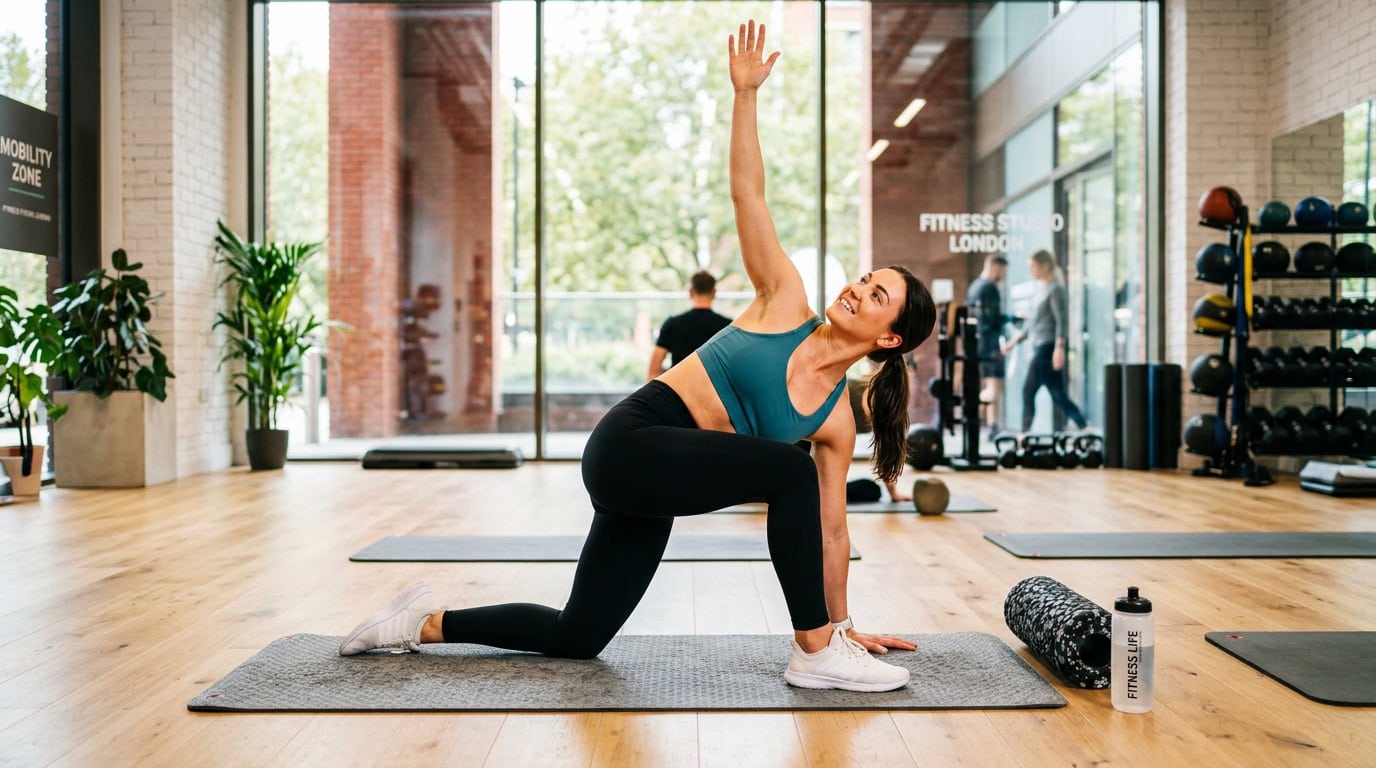
    • World’s greatest stretch: 5 per side. Lunge forward, place your elbow on the ground, rotate your arm to the sky. A full-body opener in one movement.
    • Bodyweight squats: 10 reps, focusing on depth and pushing knees out. If your heels lift, place a small plate under them.
    • Ankle circles: 10 per direction per ankle. Often overlooked but critical for squat depth.

    Upper Body Focus

    • Arm circles: 15 forward, 15 backward. Gradually increase the size.
    • Band pull-aparts: 15 reps with a light resistance band. Great for posture and shoulder health.
    • Cat-cow stretches: 10 reps on all fours. Mobilises the entire spine.
    • Thread the needle: 8 per side. From all fours, reach one arm under your body and rotate your torso. Excellent for thoracic rotation.

    After Your Workout: Static Stretching Routine (10-15 Minutes)

    Post-workout is when static stretching shines. Your muscles are warm, making them more receptive to lengthening. Hold each stretch for 30-60 seconds, breathing deeply:

    Essential Stretches for Gym-Goers

    • Standing hamstring stretch: Place one foot on a bench, hinge at the hips with a flat back. Feel the stretch in the back of your thigh, not your lower back.
    • Pigeon stretch: From all fours, bring one knee forward to the same-side wrist and extend the other leg back. Opens the hip flexors and glutes — essential for anyone who sits at a desk.
    • Wall pec stretch: Place your forearm on a wall at 90 degrees and turn your body away. Targets the chest and anterior shoulder, counteracting the hunched posture from desk work and bench pressing.
    • Couch stretch: Kneel with one knee on the floor against a wall, other foot forward in a lunge position. The single best stretch for hip flexors. Hold for 60 seconds — it’s uncomfortable, but that means it’s working.
    • Lat stretch: Grab a bar or doorframe with one hand, lean back and let your shoulder drop. Opens the lats and side of your torso.
    • Figure-four glute stretch: Lie on your back, cross one ankle over the opposite knee, and pull the bottom leg toward you. Targets the glutes and piriformis.

    Mobility Work You Can Do at Home

    You don’t need to be at the gym to improve your mobility. Here’s a simple 15-minute routine you can do in your living room, ideally on rest days or in the evening:

    1. Deep squat hold: 60 seconds. Use a doorframe for balance if needed. Push your knees out and keep your chest up.
    2. 90/90 hip switches: 10 switches. Sit with both knees bent at 90 degrees, then switch sides by lifting your legs and rotating.
    3. Thoracic spine foam rolling: 2 minutes. Lie on a foam roller across your mid-back, support your head, and extend over the roller.
    4. Shoulder dislocates: 15 reps with a broomstick or resistance band. Hold it wide, slowly bring it from in front of your body to behind and back.
    5. Ankle dorsiflexion stretch: 60 seconds per side. Kneel with one foot flat against a wall, knee touching the wall, and lean forward.

    Common Mistakes to Avoid

    • Bouncing during stretches: This triggers the stretch reflex, which actually makes the muscle tighter. Hold still and breathe.
    • Stretching cold muscles: Always do some light movement (even a brisk walk) before static stretching.
    • Ignoring pain: Stretching should feel like mild discomfort, not pain. Sharp or shooting pain means you’re going too far or there’s an existing issue that needs attention.
    • Only stretching the muscles you trained: If you sit at a desk all day, your hip flexors, chest, and hamstrings are probably tight regardless of what you trained. Address your posture-related tightness every session.
    • Doing it once and giving up: Like strength training, mobility requires consistency. Five minutes daily is far better than 30 minutes once a week.

    How Long Until You Notice a Difference?

    Most people notice improved range of motion within 2-3 weeks of consistent daily stretching. Significant mobility improvements typically take 4-8 weeks. The key word is consistent. Ten minutes every day will get you further than an hour once a fortnight.

    Find a Gym That Supports Your Goals

    The best gym for you is one that fits your lifestyle, goals, and location. Whether you’re looking for a facility with dedicated stretching zones, recovery equipment, or classes that incorporate mobility work, you can find it on GymPal. Browse thousands of UK gyms, read real reviews, and compare facilities to find the right fit for your training journey.

  • Gym Anxiety: How to Overcome the Fear of Working Out in Public

    Gym Anxiety: How to Overcome the Fear of Working Out in Public

    If the thought of walking into a gym makes your stomach flip, you’re far from alone. Gym anxiety — sometimes called “gymtimidation” — affects millions of people in the UK. In fact, research suggests that up to 50% of people feel intimidated by the gym environment at some point, and it’s one of the most common reasons people put off starting their fitness journey., mid-afternoon (2pm–4pm on weekdays), and late evenings tend to be quieter. Weekends are generally busier, so if possible, stick to weekday visits.

    3. Book an Induction

    Most UK gyms offer a free induction session when you join. This is a guided tour of the equipment with a member of staff who shows you how everything works. It’s designed for beginners, so there’s absolutely no shame in asking for one — even if you’ve been a member for a while.

    4. Wear What Makes You Comfortable

    You don’t need the latest designer activewear to have a good workout. Wear whatever makes you feel comfortable and confident. Many people start in loose-fitting clothes and gradually shift to more fitted gym wear as their confidence grows.

    5. Bring Headphones

    A good pair of headphones is your best friend at the gym. Music or podcasts create a personal bubble, help you focus, and reduce the feeling that everyone is watching you. Noise-cancelling headphones are particularly effective for blocking out the gym environment.

    6. Start Small and Build Up

    You don’t need to do an hour-long intense workout on your first visit. Start with 20–30 minutes and focus on getting comfortable in the space. Gradually increase the duration and intensity as your confidence grows. Consistency matters more than intensity in the early days.

    7. Consider a Small or Boutique Gym

    Large commercial gyms can feel overwhelming. Independent gyms, boutique studios, and specialist fitness centres often have a more intimate, community feel. They’re typically less crowded, and the staff often have more time to help newcomers feel at home. You can explore local options on GymPal — the UK’s fitness directory lets you browse gyms in your area, read what others say, and find one that suits your vibe.

    8. Remember: Everyone Was a Beginner Once

    Every single person at the gym — including the most muscular person lifting the heaviest weights — started exactly where you are now. Nobody is born knowing how to use a cable machine. Everyone had their first day, and everyone felt nervous. You belong there just as much as anyone else.

    When to Consider a Personal Trainer

    If your anxiety feels unmanageable, a few sessions with a personal trainer can make a world of difference. They’ll guide you through exercises, correct your form, and give you the confidence to train independently. Many gyms offer introductory PT sessions at a reduced rate. If you’re looking for a trainer, GymPal can help you find local gyms with personal training services.

    Signs Your Gym Anxiety Is Improving

    Progress isn’t always obvious, but here are some signs you’re heading in the right direction:

    • You no longer dread going to the gym the night before
    • You’re comfortable asking staff questions
    • You’ve tried a new piece of equipment without overthinking it
    • You stop worrying about what other people think mid-workout
    • You actually start looking forward to your gym sessions

    Final Thoughts

    Gym anxiety is a barrier, but it’s a temporary one. Every time you show up, you’re proving to yourself that you’re stronger than your doubts. Start small, be patient with yourself, and remember — the hardest part is always walking through the door.

    Ready to find a gym that feels right for you? Search Gyms on GymPal to discover local fitness options, read reviews, and find your perfect fit. Your fitness journey starts with a single step — and we’re here to help you take it.