Tag: Injury Prevention

  • Fitness After 50 UK: Strength, Balance and Staying Active

    Fitness After 50 UK: Strength, Balance and Staying Active

    Fifty used to be the age people quietly swapped squash for gardening. Not any more. Across the UK, gyms and leisure centres are seeing a steady rise in members in their 50s, 60s and beyond — people who’ve realised that strength, balance and stamina aren’t things you inevitably lose with age, but things you can actively protect, and in many cases rebuild from scratch.

    The science backs this up. Muscle mass naturally declines by around 3-8% per decade after the age of 30, and that rate speeds up again after 60 if you’re not doing anything to counter it — a process doctors call sarcopenia. But the flip side is just as encouraging: regular strength and balance work at 50, 60 or 70 can rebuild lost muscle, protect your joints, and dramatically cut your risk of the falls and fractures that cause so many hospital admissions in later life.

    This guide covers exactly what to focus on, what it’s likely to cost, how to get started without feeling out of place, and where to find the right gym, class or trainer near you. Whether you’ve been active your whole life or you’re returning to exercise after years away from it, the goal is the same: build a routine that keeps you strong, mobile and independent for decades to come.

    Why strength training becomes non-negotiable after 50

    Cardio gets most of the attention, but strength training is arguably the single most important thing you can do for your health in your 50s and beyond. Stronger muscles mean better balance, easier stairs, safer gardening, and a much lower risk of the falls that send so many older adults into A&E every year. It also protects bone density, which matters enormously for women in particular as oestrogen levels drop after the menopause.

    The NHS’s physical activity guidelines for older adults recommend muscle-strengthening activities on at least two days a week, alongside balance exercises for anyone at risk of falling. That doesn’t mean powerlifting — it means resistance bands, bodyweight moves, light dumbbells, or a properly supervised weights machine circuit, done consistently and with good form.

    Start with compound movements that mimic everyday life: sit-to-stand squats, step-ups onto a low box, seated rows, and modified push-ups against a wall or bench. Two or three sessions a week, with at least a day’s rest in between for recovery, is enough to see real strength gains within about eight weeks. Most UK gyms and leisure centres offer a free induction where an instructor will set weights and reps appropriate to your starting point — always worth booking rather than guessing your way through the weights floor.

    Protein matters more here than most people realise. As we age, our bodies become less efficient at using protein to build and repair muscle, so aim to spread protein across your meals — eggs, fish, chicken, lentils, Greek yoghurt — rather than loading it all into one dinner. Pairing that with your strength sessions gives your muscles what they actually need to adapt and grow stronger.

    Balance and fall prevention: the exercise most people skip

    Balance training doesn’t get the glory of a heavy squat personal best, but it’s just as important, and it’s the one thing most gym-goers under 40 never think about. Falls are one of the leading causes of injury-related hospital admissions among people over 65 in the UK, and the encouraging news is that balance is trainable at any age, often with surprisingly quick results.

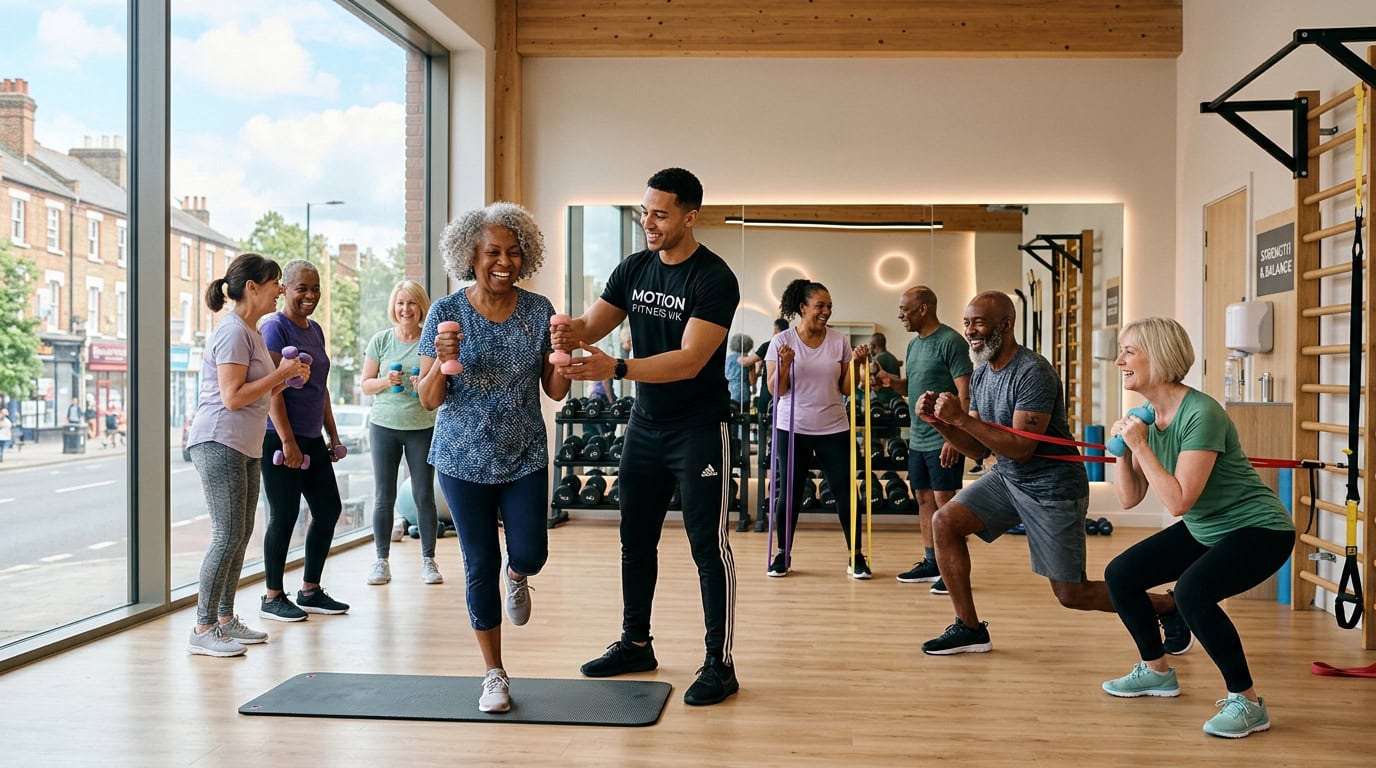
    Simple exercises make a real difference: standing on one leg while brushing your teeth, heel-to-toe walking down a hallway, or gentle tai chi and yoga classes designed specifically for older bodies. Many UK leisure centres — including large operators like Better and Everyone Active — now run dedicated “steady and strong” or falls-prevention classes, often free or heavily subsidised through local council public health budgets. It’s always worth asking reception directly what’s available, since these classes aren’t always advertised prominently online.

    If you’ve had a fall recently, or you’re worried about your balance, your GP can also refer you to an NHS-funded falls prevention programme in many parts of the country, which typically combines strength, balance and confidence-building exercises over several weeks with a qualified instructor.

    Low-impact cardio that protects your joints

    High-impact running and jumping aren’t off the table after 50, but if you’ve got creaky knees, an old injury, or you’re simply easing back into exercise, low-impact cardio lets you build fitness without the pounding. Swimming for fitness is one of the best options going — it works your whole body, supports your joints in the water, and builds real cardiovascular fitness without the impact of pavement pounding, and most UK pools run quieter adult-only or over-50s sessions during the day if a full lane full of splashing children isn’t your idea of relaxing.

    Other solid low-impact options include stationary cycling, elliptical machines, brisk walking groups, and aqua aerobics classes, which are hugely popular with the over-50s crowd precisely because the water takes the strain off your joints while your muscles still have to work hard against the resistance. Rotate between two or three low-impact activities across the week and you’ll build genuine endurance without overloading any single joint, and you’ll be far less likely to get bored and quietly stop turning up.

    Getting started when it’s been a while

    Walking into a gym for the first time in years — or ever — is intimidating at any age, and it’s a genuine reason people put off starting altogether. If the thought of a room full of twenty-somethings on the squat rack fills you with dread, you’re far from alone, and there are practical ways to work through gym anxiety before it stops you getting started at all.

    Booking an induction session, visiting during quieter mid-morning hours, or choosing a smaller independent studio over a huge budget chain can all take the edge off that first visit. Most staff are used to helping people ease back into training and will happily walk you through equipment at your own pace rather than expecting you to already know your way around it.

    On cost, most council-run leisure centres offer concessionary or senior membership rates, often 20-30% cheaper than standard adult pricing, sometimes starting from around £25-£35 a month, with pay-as-you-go sessions typically £5-£8. Independent gyms and boutique studios tend to sit higher, but many run senior-specific class blocks at a discount. Some GPs can also refer eligible patients onto local authority “exercise on referral” schemes, which subsidise gym or leisure centre access for a set period — worth asking your surgery about if cost is the main barrier.

    Getting a programme built around your body

    Generic workout plans rarely account for old injuries, joint issues, or the simple fact that your recovery time isn’t what it was at 25. This is where a bit of personalised guidance really pays off. Working with a qualified personal trainer — even for just a handful of sessions to learn safe technique — can save you months of trial and error and help you avoid the overuse injuries that come from doing too much, too soon.

    Look specifically for trainers with experience working with older clients or a recognised qualification in exercise for older adults; many independent gyms and leisure centres list this as a specialism on their trainer profiles, and it’s worth asking directly rather than assuming every trainer has the relevant background. A good trainer will also build in mobility and recovery work, not just sets and reps, which matters more the further you get from your twenties.

    Recovery matters as much as the workout itself

    One of the biggest mistakes people make when they start training later in life is treating recovery as optional. Sleep, hydration and rest days aren’t a sign you’re not working hard enough — they’re the part of the process where your muscles actually repair and get stronger. Skimping on recovery is one of the fastest routes to a nagging injury that puts you off exercise altogether.

    Build at least one full rest day between strength sessions, stretch or foam-roll after cardio, and don’t ignore joint pain that lingers for more than a couple of days — get it checked rather than pushing through it. A slower, more sustainable build-up will get you further than an ambitious plan that has you sidelined with an injury by week three.

    Building a routine that actually sticks

    The best fitness plan after 50 isn’t the most intense one — it’s the one you’ll still be doing in five years. Aim for a realistic mix across the week: two strength sessions, one or two low-impact cardio sessions, and a bit of balance or mobility work most days, even if it’s just ten minutes while the kettle boils.

    Consistency matters more than intensity here. A gentle 30-minute swim three times a week, done reliably, will do more for your long-term health than an occasional brutal class you dread and skip half the time. If you’re not sure what’s available locally, searching GymPal’s directory of UK gyms, pools and studios is a quick way to compare facilities, class timetables and prices near you before committing to a membership.

    The takeaway

    Fifty isn’t a finish line for fitness — for a lot of people, it’s where things genuinely click into place, because you finally have the time and motivation to do it properly. Prioritise strength and balance work, keep your cardio joint-friendly, ease in gently if you’re new to it, fuel and rest properly, and don’t be afraid to get some professional guidance for the first few weeks.

    Ready to find the right gym, pool or studio near you? Search GymPal to compare facilities, classes and prices across the UK and find somewhere that suits exactly where you’re at, whatever your starting point.

  • Why Rest Days Are Non-Negotiable: The Science Behind Recovery and Muscle Growth

    Why Rest Days Are Non-Negotiable: The Science Behind Recovery and Muscle Growth

    If you’re hitting the gym five, six or even seven days a week and wondering why your progress has stalled, the answer might not be more training — it might be more rest. Rest days are one of the most underrated elements of any fitness programme, yet they’re essential for muscle repair, injury prevention, and long-term motivation. and testosterone (repair)

  • Reduces systemic inflammation built up from repeated training
  • Consolidates neuromuscular adaptations — your nervous system literally “learns” the movements

Skip the rest and you’re essentially tearing down without ever rebuilding.

How Many Rest Days Do You Need?

There’s no single answer, but most UK-based fitness professionals recommend at least one to two full rest days per week. Here’s a rough guide based on training intensity:

  • Beginners (0–6 months): 2–3 rest days per week. Your body is adapting to entirely new stresses.
  • Intermediate (6–24 months): 1–2 rest days per week, with at least one deload week every 6–8 weeks.
  • Advanced (2+ years): 1 rest day per week minimum, plus scheduled deload periods. Even elite athletes programme recovery.

If you’re consistently feeling fatigued, sore for days on end, or seeing your performance plateau, that’s your body telling you to ease off.

Active Recovery vs. Full Rest

Not all rest days need to mean sitting on the sofa. Active recovery — light movement that gets blood flowing without taxing your muscles — can actually speed up the repair process. Good options include:

  • A brisk 20–30 minute walk
  • Gentle yoga or mobility stretching
  • Swimming at a relaxed pace
  • Light cycling
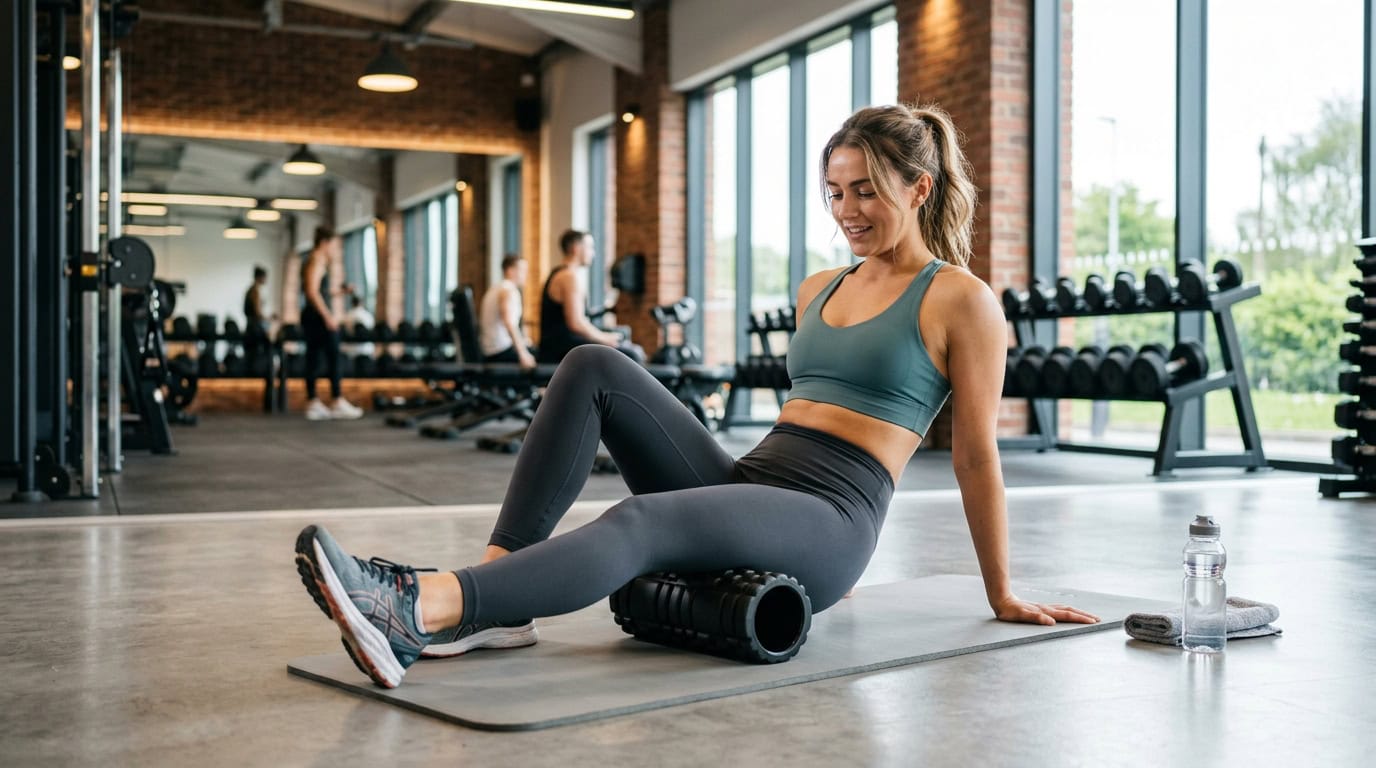
  • Foam rolling and targeted stretching

The key is keeping your heart rate low and avoiding anything that leaves you sore afterwards. Think of it as lubricating the joints and flushing out waste products, not burning calories.

Signs You’re Not Resting Enough

Overtraining syndrome is real and can set your progress back by weeks or months. Watch out for these warning signs:

  • Persistent soreness — muscles that never fully recover between sessions
  • Stalled strength gains — you can’t increase your weights or reps despite consistent effort
  • Poor sleep — ironically, overtraining can disrupt the very sleep you need for recovery
  • Mood changes — irritability, lack of motivation, or feeling “flat”
  • Frequent illness — a suppressed immune system is a classic overtraining symptom
  • Elevated resting heart rate — check yours first thing in the morning; a rise of 5–10 bpm can indicate inadequate recovery

If more than two of these sound familiar, schedule a full week of reduced training or complete rest.

Nutrition on Rest Days Matters Too

A common mistake is slashing calories on rest days because you’re not burning as much. Don’t. Your body needs protein, carbohydrates and healthy fats to repair tissue and replenish energy stores. In fact, your protein requirements remain just as high on rest days as they do on training days.

Aim for:

  • 1.6–2.2g of protein per kg of bodyweight spread across meals
  • Plenty of hydrating fluids — water, herbal teas, electrolyte drinks if you sweat heavily
  • Complex carbohydrates like oats, sweet potatoes and brown rice to refuel glycogen
  • Anti-inflammatory foods — oily fish, berries, leafy greens, nuts and seeds

Making Rest Work for Your Schedule

The best rest day is the one you actually take. Plan your week so that rest days are built into your routine rather than something you squeeze in when you feel broken. A popular split for UK gym-goers training four days a week looks like this:

  • Monday: Upper body
  • Tuesday: Lower body
  • Wednesday: Rest or active recovery
  • Thursday: Push / pull
  • Friday: Full body or cardio
  • Saturday: Rest
  • Sunday: Rest or light activity

The exact split matters less than the consistency. Pick something sustainable and stick with it for at least eight weeks before reassessing.

Find the Right Gym for a Balanced Programme

A good rest day strategy only works if your training days are equally well-planned. That starts with choosing a gym that suits your goals, schedule and budget. Whether you need 24-hour access for early-morning sessions, a well-equipped free weights area, or recovery facilities like a sauna and stretch zone, GymPal makes it easy to search and compare gyms across the UK.

GymPal lists thousands of fitness facilities — from budget-friendly chains to boutique studios — with details on equipment, opening hours, pricing and member reviews. It’s the quickest way to find a gym that fits your life, so you can train hard on your training days and actually enjoy your rest days.

The Bottom Line

Rest isn’t laziness — it’s where the magic happens. Every personal trainer, physio and sports scientist worth listening to will tell you the same thing: you don’t get fitter while you train, you get fitter while you recover from training. So next time you feel guilty about skipping a session, remember that your rest day might be the most productive thing you do all week.

Train hard, recover harder, and use tools like GymPal to find the perfect gym for your fitness journey.

  • How to Find the Right Personal Trainer in the UK: A Complete Guide

    How to Find the Right Personal Trainer in the UK: A Complete Guide

    A Good PT Is Worth Every Penny

    If you are training consistently but feel like your progress has stalled, you are confused about programming, or you have a specific goal that requires expert guidance, a personal trainer could be the catalyst that transforms your results. that requires structured programming

  • You struggle with consistency and need accountability
  • You are returning from an injury and need safe, progressive programming
  • You probably do not need a PT if:

    Qualifications: What to Look For

    A qualified PT in the UK should hold at minimum:

    Additional qualifications that indicate specialisation:

    Ask about qualifications before signing up. A reputable PT will be happy to show you their certificates.

    Where to Find Personal Trainers

    At Your Gym

    The easiest option. Most gyms have in-house PTs or allow external trainers to operate within the facility. Ask at reception or check the gym’s website. Advantages include convenience, a known facility, and potentially discounted rates for members.

    On GymPal

    GymPal lists thousands of UK gyms, many of which feature PT profiles or contact details. You can search for gyms with personal training services in your area and enquire directly.

    Online Directories

    Social Media

    Instagram and TikTok are where many UK PTs showcase their work. Search for personal trainers in your area and look for:

    Avoid PTs whose feed is entirely motivational stock images and “hustle culture” content. The best PTs educate and demonstrate their expertise.

    Questions to Ask Before Hiring a PT

    Before committing to a PT, have an initial conversation (many offer a free consultation). Ask these questions:

    1. What are your qualifications and how long have you been training?
    2. Do you specialise in any particular area? (weight loss, strength, sports performance, rehabilitation, etc.)
    3. How do you structure your programmes? (should be periodised and progressive, not random)
    4. How do you track progress? (should measure and adjust regularly)
    5. What happens if I need to cancel or reschedule? (flexibility is important)
    6. Can I see testimonials or speak to current or past clients?
    7. How do you handle injuries or limitations?

    A good PT will answer these questions confidently and in detail. A poor PT will be vague or evasive.

    Understanding PT Pricing in the UK

    Session Type Typical Price
    1-to-1 session (60 min) £30–75
    1-to-1 session (45 min) £25–55
    Small group (2-3 people) £15–25 per person
    Online coaching (monthly) £80–200/month
    Block of 5 sessions £140–335 (5-10% discount)
    Block of 10 sessions £260–650 (10-15% discount)

    London and the South East command the highest rates. Expect to pay £40–75 per hour in London and £25–50 in most other UK cities and towns.

    What to Expect for Your Money

    A good PT session should include:

    A bad PT will spend the session chatting, count your reps, and send you on your way without meaningful coaching or progression.

    Red Flags to Watch For

    Types of Personal Training

    In-Person 1-to-1

    The traditional model. You meet your PT at your gym for face-to-face sessions. Best for beginners who need hands-on coaching and technique correction.

    Online Coaching

    Your PT programmes your workouts, tracks your progress, and checks in via an app or video call, but you train on your own. Significantly cheaper (£80–200/month vs £120–180 for in-person). Best for experienced trainees who are confident with technique and want structured programming at a lower cost.

    Small Group / Semi-Private

    Train with 2-4 other people under one PT. Cost per person is lower while still getting coaching and programming. Best for friends with similar goals or budget-conscious trainees.

    Specialist Coaching

    PTs who focus on specific areas: weight loss, sports performance, powerlifting, bodybuilding, rehabilitation, pre/post-natal, or older adults. If you have a specific goal, a specialist is worth the investment.

    Getting the Most from Your PT

    The Bottom Line

    A good personal trainer is one of the best investments you can make in your fitness journey. They provide expertise, accountability, and programming that is difficult to replicate on your own. The key is finding the right one — qualified, experienced, communicative, and genuinely invested in your results.

    Start with your gym’s in-house PTs, check qualifications, ask the right questions, and commit to at least 8 weeks. If you do your research and choose wisely, a PT can be the difference between training hard and training smart.


    Need to find a gym with quality personal trainers? Search GymPal to find UK gyms with PT services near you. Compare facilities, read member reviews, and claim a free trial to meet the team before committing.

  • How to Avoid Common Gym Injuries: A Prevention Guide for Beginners

    How to Avoid Common Gym Injuries: A Prevention Guide for Beginners

    Nothing Derails Progress Faster Than an Injury

    You have been training consistently for six weeks. The weights are going up, you are feeling good, and then — a sharp pain in your shoulder during a bench press. Two weeks later, you are still not back to full training. Worse, you have lost motivation and are questioning whether the gym is worth it.

    What it is: A muscle strain or ligament sprain in the lower back, caused by excessive loading with poor form.

    How it happens: Deadlifting, squatting, or rowing with a rounded lower back; using too much weight before mastering technique; sitting for long periods then immediately loading the spine.

    Prevention:

    • Learn and maintain a neutral spine position for every lift
    • Warm up your back with cat-cow stretches and bird-dog exercises before deadlifts or squats
    • Strengthen your core — planks, dead bugs, and hollow body holds support your spine under load
    • Start light and progress gradually — ego lifting is the number one cause of back injuries

    2. Shoulder Impingement

    What it is: Pain in the front or side of the shoulder when raising the arm, caused by inflammation of the rotator cuff tendons.

    How it happens: Overhead pressing with poor scapular positioning; bench pressing too frequently without balancing pulling movements; behind-the-neck lat pulldowns; inadequate warm-up.

    Prevention:

    • Pull as much as you push — for every pressing exercise, include a pulling exercise
    • Warm up shoulders with arm circles, band pull-aparts, and face pulls
    • Avoid behind-the-neck pulldowns — use front pulldowns instead
    • Do not bench press heavy every session — vary your exercises
    • Strengthen the rotator cuff with external rotations using a light band

    3. Knee Injuries (Patellar Tendinitis / Meniscus)

    What they are: Pain at the front of the knee (patellar tendinitis) or a sharp pain with twisting (meniscus tear).

    How they happen: Squatting with knees caving inward (valgus collapse); landing hard from box jumps; running on treadmills at high speeds with poor form; sudden changes in training volume.

    Prevention:

    • Learn proper squat mechanics — push your knees out over your toes, track them in line with your feet
    • Strengthen the VMO (vastus medialis oblique) with leg extensions, split squats, and lunges
    • Warm up knees with bodyweight squats and hip circles
    • Land softly and softly from jumps — never lock your knees on landing
    • Do not increase running speed or distance by more than 10% per week

    4. Rotator Cuff Tear

    What it is: A partial or full tear of one of the four muscles that stabilise the shoulder joint.

    How it happens: Sudden heavy loading on an unprepared shoulder; chronic impingement that weakens the tendon until it tears; bench pressing or overhead pressing with excessive range of motion.

    Prevention:

    • Strengthen the rotator cuff with light band work (external and internal rotations)
    • Progress pressing movements slowly — do not jump to heavy weights
    • Warm up shoulders thoroughly before any overhead or pressing work
    • If you feel shoulder pain during pressing, stop immediately and assess

    5. Neck Strain

    What it is: A muscle strain in the cervical spine, causing pain, stiffness, and limited range of motion.

    How it happens: Straining the neck during heavy lifts (squats, overhead press) by craning to look at the mirror or at the weight; poor bench press setup with excessive neck arch; poor posture during seated exercises.

    Prevention:

    • Keep a neutral neck position during all exercises — your head should be in line with your spine
    • Do not look up or around during heavy lifts — focus your eyes straight ahead
    • Strengthen your neck with isometric holds (push your head into your hand in each direction and hold)
    • Set up bench press properly with shoulder blades retracted and feet on the floor

    6. Muscle Strains (Hamstrings, Groin, Calf)

    What they are: Tears in the muscle fibres, typically caused by sudden stretching under load.

    How they happen: Sprinting without warming up; deadlifting with rounded back (hamstring); deep lunges or squats with insufficient mobility (groin); jumping without warm-up (calf/Achilles).

    Prevention:

    • Dynamic stretching before any explosive or high-speed work
    • Progressive loading — do not suddenly attempt a weight significantly heavier than your usual
    • Build mobility gradually — do not force your body into positions it is not ready for
    • Strengthen muscles eccentrically (slow lowering phase) to build resilience

    7. Wrist Strain

    What it is: Pain and inflammation in the wrist, common in pressing movements and exercises like cleans and snatches.

    How it happens: Excessive wrist extension under load (bench press, overhead press); heavy barbell movements without wrist wraps; poor grip technique.

    Prevention:

    • Keep your wrists neutral (straight, not bent backwards) during pressing movements
    • Use wrist wraps for heavy pressing or overhead work
    • Strengthen your forearms with wrist curls and reverse wrist curls
    • Take breaks from heavy pressing if you feel wrist discomfort

    Universal Injury Prevention Rules

    Beyond specific exercises, these principles apply to every gym session:

    1. Warm Up Properly (5-10 Minutes)

    Never skip this. A proper warm-up increases blood flow, raises tissue temperature, and prepares your joints for the work ahead. Use the dynamic stretching routine from our stretching guide before every session.

    2. Master Form Before Adding Weight

    Ego is the enemy of longevity. If you cannot perform an exercise with good form using just the bar or light dumbbells, you have no business adding weight. Film yourself from the side to check your form.

    3. Progress Gradually

    The general rule: increase weight by no more than 2.5-5% per week. Increase volume (sets/reps) by no more than 10% per week. Sudden jumps in training load are the number one predictor of injury.

    4. Balance Your Training

    • Push and pull in equal volume
    • Train upper and lower body
    • Include horizontal and vertical pulling movements
    • Include core work in every programme

    Imbalances create weak points that are more susceptible to injury.

    5. Listen to Your Body

    There is a difference between productive discomfort (muscle burn, fatigue) and pain (sharp, shooting, joint-related). If something feels wrong, stop. Pushing through joint pain is how small injuries become big ones.

    6. Get Enough Rest and Recovery

    Muscles do not grow during training — they grow during rest. If you are training the same muscle group hard every day, you are accumulating damage without allowing repair. Allow 48-72 hours between sessions for the same muscle group.

    7. Deload Regularly

    Every 4-8 weeks, take a deload week: reduce your volume and/or intensity by 40-50%. This allows your body to fully recover and adapt, reducing your long-term injury risk while actually improving performance.

    What to Do If You Get Injured

    1. Stop the exercise immediately. Do not push through sharp or joint pain.
    2. Assess the severity. If it is mild discomfort, modify the exercise. If it is sharp or shooting pain, stop training that area entirely.
    3. Apply RICE for the first 48 hours: Rest, Ice, Compression, Elevation. This reduces inflammation and promotes healing.
    4. See a professional if: Pain persists beyond a week, you heard a pop during the injury, or you cannot move the joint through its normal range.
    5. Do not rush back. Returning to training before an injury has fully healed is the most common cause of recurring injuries.

    Choosing a Gym That Supports Injury Prevention

    The right gym environment helps you train safely:

    • Well-maintained equipment that functions correctly
    • Floor coaches who can check your form
    • Space to move without colliding with other members
    • Warm-up and stretching areas
    • Recovery facilities (sauna, ice bath)

    When you are choosing a gym, these factors matter more than the number of machines or the price. GymPal helps you find UK gyms with the facilities and atmosphere that support safe, long-term training.

    The Bottom Line

    Gym injuries are frustrating, painful, and demotivating — but they are almost entirely preventable. The vast majority of injuries come down to three things: poor form, too much weight too soon, and inadequate recovery.

    Warm up properly, master your technique before loading up, progress gradually, balance your training, and rest when your body tells you to. Do these things consistently and you will train injury-free for years.


    Ready to start training safely? Search GymPal to find UK gyms with well-maintained equipment, floor coaches, warm-up areas, and recovery facilities. Train smart, train safe, and train long.

  • Stretching for Beginners: The Only Stretches You Need Before and After the Gym

    Stretching for Beginners: The Only Stretches You Need Before and After the Gym

    Stretching Is the Most Skipped Part of Working Out

    Walk into any commercial gym and you will see the same pattern: people rush in, spend 30 seconds doing a half-hearted arm swing, jump straight into their workout, and leave as soon as they finish their last set. No warm-up. No cool-down. No stretching.

  • Improved blood flow: Stretching increases circulation to your muscles, delivering oxygen and nutrients
  • Better posture: Regular stretching of tight muscles (chest, hip flexors, shoulders) counteracts the effects of sitting at a desk all day
  • Before Your Workout: Dynamic Stretches (5 Minutes)

    Before training, you should do dynamic stretches — movements that take your joints through their full range of motion while increasing blood flow. Static stretching (holding a stretch in place) before training can actually reduce power output. Save that for afterwards.

    1. Arm Circles (30 seconds)

    Stand tall and make large forward circles with both arms for 15 seconds, then reverse direction for 15 seconds. Loosens the shoulder joints and warms up the rotator cuff muscles.

    2. Leg Swings (30 seconds each leg)

    Hold onto a wall or rack for balance. Swing one leg forward and backward in a controlled motion, gradually increasing the range. Switch legs. Warms up the hip flexors, glutes, and hamstrings.

    3. Hip Circles (30 seconds)

    Stand with feet shoulder-width apart. Place your hands on your hips and make large circles with your hips, 15 seconds clockwise and 15 seconds anti-clockwise. Mobilises the hip joints, which are involved in almost every lower body exercise.

    4. Bodyweight Squats (10 reps)

    Perform 10 slow, controlled bodyweight squats, going as deep as your mobility allows. This activates your quads, glutes, and hips while warming up the pattern you will use under load.

    5. Inchworms (5 reps)

    Stand tall, bend forward and touch your toes (or shins), walk your hands out to a plank position, hold for a moment, then walk your feet to your hands and stand up. Stretches the hamstrings, calves, and shoulders while activating the core.

    6. Torso Twists (30 seconds)

    Stand with arms extended to the sides. Rotate your torso left and right in a controlled motion. Mobilises the thoracic spine, which is important for overhead movements and squats.

    After Your Workout: Static Stretches (5-10 Minutes)

    After training, your muscles are warm and pliable — the ideal time for static stretching. Hold each stretch for 20-30 seconds, breathing deeply. Never bounce or force a stretch beyond mild discomfort.

    1. Chest Stretch (20-30 seconds each side)

    Stand in a doorway and place your forearm against the door frame with your elbow at shoulder height. Gently lean forward until you feel a stretch across your chest. This counteracts the hunched posture from desk work and pressing movements.

    2. Lat Stretch (20-30 seconds each side)

    Kneel in front of a bench or place your hands on a wall. Reach forward with both arms and let your chest drop toward the floor. You should feel a stretch along the sides of your back. Important for anyone doing pull-ups, rows, or lat pulldowns.

    3. Standing Quad Stretch (20-30 seconds each leg)

    Stand on one leg (hold a wall for balance). Grab your other ankle behind you and pull your heel towards your glutes. Keep your knees close together and push your hips slightly forward. Targets the quadriceps and hip flexors.

    4. Seated Hamstring Stretch (20-30 seconds each leg)

    Sit on the floor with one leg extended and the other foot against your inner thigh. Reach towards your toes of the extended leg until you feel a stretch in the back of your thigh. Keep your back straight. Targets the hamstrings.

    5. Figure-Four Glute Stretch (20-30 seconds each side)

    Lie on your back with knees bent. Place one ankle on the opposite knee, then pull the bottom knee towards your chest. You should feel a deep stretch in your glute. Essential for anyone who squats, deadlifts, or sits for long periods.

    6. Shoulder Cross-Body Stretch (20-30 seconds each side)

    Bring one arm across your body and use your other hand to gently pull it closer to your chest. Keep the stretched arm straight. Targets the rear deltoid and upper back.

    7. Calf Stretch (20-30 seconds each side)

    Stand facing a wall with one foot forward. Press your heel into the floor and lean towards the wall until you feel a stretch in your calf. Keep the back leg straight. Targets the gastrocnemius (calf muscle).

    8. Cat-Cow (10 slow reps)

    Start on your hands and knees. Alternate between arching your back (cow) and rounding it (cat) in a slow, controlled motion. Mobilises the entire spine and releases tension in the lower back after heavy lifting.

    Common Stretching Mistakes

    When to Stretch on Rest Days

    Dedicated stretching or mobility sessions on rest days can accelerate your progress. Consider:

    Many UK gyms now offer dedicated mobility or yoga classes as part of their membership. If yours does, it is worth trying. If you are looking for a gym with recovery and mobility facilities, GymPal lets you filter by class types and amenities.

    The Bottom Line

    Stretching is not glamorous, but it is one of the most impactful habits you can build as a beginner. Five minutes of dynamic stretching before training prepares your body for the work ahead. Five to ten minutes of static stretching afterwards aids recovery and improves long-term mobility.

    The routines above cover every major muscle group and take less than 15 minutes total. That is a small investment for significantly better performance, fewer injuries, and a body that moves better both inside and outside the gym.


    Need a gym with the space and facilities to stretch properly? Search GymPal to find UK gyms with dedicated stretching areas, yoga classes, mobility zones, and recovery facilities. Compare options and claim a free trial.

  • Climbing and Bouldering Gyms in the UK: A Complete Beginner Guide

    Climbing and Bouldering Gyms in the UK: A Complete Beginner Guide


    <a href="https://askgympal.co.uk/blog/climbing-bouldering-gyms-uk-complete-beginners-guide/" target="_blank" rel="dofollow" >Climbing</a> and Bouldering Gyms in the UK: A Complete Beginner Guide

    The UK Climbing Boom

    Climbing and bouldering have exploded in popularity across the UK over the past decade. What was once seen as a niche outdoor pursuit is now one of the fastest-growing fitness activities, with over 300 climbing walls and bouldering centres across the country. The inclusion of sport climbing in the Tokyo 2020 Olympics gave the sport a massive visibility boost, and participation has been climbing ever since. According to Sport England Active Lives survey

    There are good reasons for the surge. Climbing and bouldering offer a unique combination of physical challenge, mental problem-solving, and community spirit that is hard to find in traditional gyms. They build full-body strength, grip, flexibility, and mental resilience — and most people find them genuinely enjoyable in a way that treadmill running simply is not.

    If you are curious but have never tried it, this guide covers everything you need to know before your first session.

    Climbing vs Bouldering: What Is the Difference?

    These terms are often used interchangeably, but they refer to different activities. Understanding the distinction helps you choose the right gym and the right experience:

    Feature Bouldering Rope Climbing
    Height Up to 4–5 metres (walls are low) 10–15+ metres (walls are tall)
    Safety Thick crash mats below; no ropes or harnesses needed Ropes and harnesses required; belayer needed
    Equipment needed Just climbing shoes and chalk (usually available to hire) Shoes, chalk, harness, and belay device
    Training required None for bouldering walls (watch the safety video on arrival) Must complete a belay training course (usually 1–2 hours)
    Cost Lower (less equipment, no instruction required) Higher (training course, equipment hire, or partner required)
    Social Very social — people chat between attempts and share beta More focused on the belay partnership
    Physical intensity Short, powerful bursts of effort Sustained effort over longer routes
    Best for beginners Yes — the easiest entry point Yes, but requires a training course first

    Most UK climbing centres offer both bouldering and rope climbing under one roof. If you are completely new, start with bouldering. It is cheaper, requires less equipment and training, and gives you an immediate sense of what climbing feels like.

    What to Expect on Your First Visit

    Arrival and Registration

    When you arrive at a climbing centre, you will need to register. For bouldering, this typically involves:

    1. Signing a waiver (standard at all climbing centres)
    2. Watching a short safety video (covers falling technique, mat awareness, and wall rules)
    3. Hiring shoes and chalk if you do not have your own

    The whole process takes about 10–15 minutes. Staff at UK climbing centres are generally very welcoming to beginners — do not be afraid to ask questions.

    The Grading System

    Climbing routes (called “problems” in bouldering) are colour-coded and graded by difficulty. In the UK, bouldering grades typically use the V-scale or the Font scale:

    Grade Level What to Expect
    V0 / Font 3 Beginner Simple moves, big holds, straightforward
    V1–V2 / Font 4–5 Easy Slightly harder, requires basic technique
    V3–V4 / Font 6A–6B Intermediate Requires technique, strength, and problem-solving
    V5–V7 / Font 6C–7A Advanced Significant strength, flexibility, and skill required
    V8+ / Font 7B+ Expert Elite-level climbing

    On your first visit, look for the easiest colour on the wall and start there. There is no shame in starting at the bottom — every climber did.

    How a Bouldering Session Works

    A typical bouldering session looks like this:

    1. Warm up: 10 minutes of light cardio, dynamic stretching, and easy traversing (climbing sideways along the bottom of the wall)
    2. Choose a problem: Pick a colour that looks manageable and study the holds from the ground
    3. Climb: Start from the marked start holds, follow the colour to the top hold, and climb back down (never jump off)
    4. Rest: Bouldering is intense. Rest 2–3 minutes between attempts
    5. Repeat: Try the same problem a few times, then move to a different one
    6. Cool down: Light stretching and forearm exercises

    A typical session lasts 60–90 minutes. Your forearms will tell you when you are done.

    How Much Does Climbing Cost in the UK?

    Item Typical Cost
    Bouldering entry (day pass) £8–15
    Rope climbing entry (day pass) £10–18
    Shoe hire £2–4
    Chalk bag hire £1–2
    Belay training course £30–50 (one-off, 1–2 hours)
    Monthly membership (unlimited) £50–90
    Off-peak membership £35–60

    Day passes make climbing easy to try without commitment. Many centres offer introductory packages (entry + shoe hire + chalk) for around £10–15. Monthly memberships are competitive with traditional gym prices, and most include both bouldering and rope climbing.

    The Physical Benefits of Climbing

    Climbing is one of the most comprehensive full-body workouts available. Here is what it trains:

    • Grip strength: Your forearms, fingers, and hands get an incredible workout
    • Upper body: Back, shoulders, biceps, and chest all engage on every climb
    • Core: Keeping your body close to the wall requires constant core activation
    • Legs: Surprisingly, your legs do most of the pushing. Climbing is not all upper body
    • Flexibility: Reaching for holds in awkward positions improves hip and shoulder mobility
    • Balance and coordination: Every move requires body awareness and precise weight shifting

    Because climbing is inherently varied (every problem is different), it avoids the repetitive strain patterns of traditional weight training. It also builds functional strength that translates to real-world movement.

    The Mental Benefits

    Climbing is often described as physical chess. Each problem requires you to:

    • Read the sequence of moves from the ground
    • Plan your body position and weight distribution
    • Adapt when your plan does not work
    • Overcome the fear of falling (in a controlled, safe environment)
    • Persist through repeated failure until you succeed

    This combination of physical exertion and mental problem-solving makes climbing uniquely absorbing. It is very difficult to think about work stress when you are three metres up a wall trying to figure out where to put your left foot. Many climbers describe the experience as meditative.

    Finding a Climbing Gym Near You

    The UK has climbing walls in most cities and many larger towns. Some of the best-known chains include:

    Chain Locations Known For
    The Climbing Hangar Liverpool, London, Birmingham, Harrogate Bouldering-focused, strong community
    Boulder Shack Exeter, Plymouth Bouldering specialist
    Clip n Climb Nationwide (franchise) Family-friendly, auto-belay, beginner-focused
    The Depot Leeds, Sheffield, Birmingham Large facilities, bouldering and rope climbing
    Rocking Frog Manchester, Nottingham Bouldering, training boards, youth programmes
    Creation Climbing London (multiple) Bouldering-focused, modern walls
    Awesome Walls Liverpool, Sheffield, Stockport Huge facilities, both bouldering and rope

    Beyond the chains, many independent walls offer excellent experiences. To find climbing gyms near you — including independent operators and specialist centres — GymPal lists thousands of UK gyms with filtering by facilities, location, and member reviews.

    What to Bring to Your First Session

    • Climbing shoes (or hire them at the centre — £2–4)
    • Chalk bag (or hire one — £1–2)
    • Comfortable clothes — leggings or shorts and a t-shirt work well. Avoid anything too loose or restrictive.
    • Water bottle — climbing is deceptively thirsty work
    • A friend (optional but recommended) — climbing is more fun with company, and you can spot each other

    Common Beginner Mistakes

    • Using too much arm strength. Your legs should do most of the work. Push with your feet, pull with your arms.
    • Not warming up. Climbing places intense stress on finger tendons. Always warm up thoroughly.
    • Climbing to exhaustion every session. Tendon injuries from overtraining are the most common climbing injury. Stop before your forearms give out completely.
    • Skipping easier problems. Even experienced climbers warm up on easy problems. Build up gradually.
    • Jumping off the wall. Always climb down. Jumping from height onto crash mats is the most common source of ankle injuries in bouldering.
    • Being intimidated. Every climber was a beginner once. The climbing community is famously welcoming.

    Should You Combine Climbing with Gym Training?

    Many climbers find that supplementing their climbing with gym training improves their performance. Key exercises include:

    • Pull-ups and rows — build back and bicep strength for pulling on holds
    • Deadlifts and squats — build leg and posterior chain strength for powerful moves
    • Planks and hollow body holds — core strength for body tension on the wall
    • Forearm exercises — wrist curls, dead hangs, and fingerboarding (advanced only)

    If you are looking for a gym that complements your climbing training, GymPal can help you find UK gyms with the right equipment and training atmosphere.

    The Bottom Line

    Climbing and bouldering offer something rare in fitness: an activity that is physically demanding, mentally engaging, and genuinely fun. The barrier to entry is low (a day pass and shoe hire is all you need), the community is welcoming, and the benefits extend far beyond physical fitness.

    If you have been curious about climbing, there has never been a better time to try. Find a local wall, book a day pass, and give it a go. You might just find your new favourite way to stay fit.


    Looking for a climbing gym near you? Search GymPal to find UK bouldering walls and climbing centres in your area. Filter by facilities, read member reviews, and compare day pass and membership prices.


  • How Recovery Days Can Speed Up Your Fitness Progress

    How Recovery Days Can Speed Up Your Fitness Progress


    How Recovery Days Can Speed Up Your Fitness Progress

    Why Skipping Rest Days Is Holding You Back

    If you are hitting the gym six or seven days a week and wondering why your progress has stalled, the answer might be simpler than you think: you are not recovering enough. Rest days are not a sign of weakness — they are where the real gains happen. According to ukactive State of the UK Fitness Industry report

    When you train, you create microscopic tears in your muscle fibres. It is during rest that your body repairs those tears, building muscle that is stronger and more resilient than before. Without adequate recovery, you are constantly breaking down without ever giving your body the chance to rebuild.

    The Science Behind Recovery

    Exercise triggers an inflammatory response in your body. This is completely normal and actually necessary for growth. However, chronic inflammation from overtraining can flip from productive to destructive. Studies published in the Journal of Strength and Conditioning Research show that muscles need 48 to 72 hours to fully recover after an intense session.

    During recovery, your body is busy:

    • Repairing muscle tissue — satellite cells activate to patch up damaged fibres
    • Replenishing glycogen stores — your muscles refuel their energy reserves
    • Releasing growth hormone — particularly during deep sleep, which drives muscle development
    • Reducing cortisol levels — chronic stress hormone that breaks down muscle tissue

    Signs You Need More Recovery Time

    Your body is remarkably good at telling you when something is off — if you know what to look for. Watch for these common red flags:

    Symptom What It Means
    Persistent muscle soreness lasting 3+ days Delayed onset muscle soreness (DOMS) that will not shift
    Plateaued lifts or declining performance Your muscles have not recovered enough to handle the same load
    Disrupted sleep patterns Overtraining elevates cortisol, making restful sleep harder
    Frequent minor illnesses or nagging injuries Your immune system is suppressed from chronic stress
    Mood changes or low motivation Mental burnout often mirrors physical overtraining

    If you are ticking two or more of these boxes, it is time to rethink your schedule.

    How to Structure Your Recovery Days

    A proper recovery day does not mean collapsing on the sofa. Active recovery keeps blood flowing to your muscles without adding stress. Here is how to make the most of your days off:

    1. Light Movement

    A 20 to 30-minute walk, gentle swim, or easy cycle gets your blood circulating and helps flush out metabolic waste from your muscles. Yoga and stretching are also excellent options — many UK gyms now offer dedicated recovery or mobility classes.

    2. Prioritise Sleep

    This is non-negotiable. Aim for seven to nine hours per night. During deep sleep, your body releases the majority of its human growth hormone (HGH). Poor sleep directly undermines everything you do in the gym.

    3. Nutrition and Hydration

    Recovery days are when you should be fuelling up. Focus on lean protein to support muscle repair, complex carbohydrates to replenish glycogen, and plenty of water. A common mistake is drastically cutting calories on rest days — your body needs those nutrients to rebuild.

    4. Foam Rolling and Self-Myofascial Release

    Spend 10 to 15 minutes with a foam roller targeting major muscle groups. This helps break up fascial adhesions, improves range of motion, and can reduce next-day soreness by up to 30% according to research from the International Journal of Sports Physical Therapy.

    5. Contrast Therapy

    Alternating between hot and cold exposure — such as a warm shower followed by 30 seconds of cold water — can improve circulation and reduce inflammation. Some UK gyms now offer ice baths and saunas, which take this to the next level.

    Sample Training Week with Built-In Recovery

    Here is a balanced weekly structure that works for most intermediate lifters:

    Day Activity Intensity
    Monday Strength training (upper body) High
    Tuesday Strength training (lower body) High
    Wednesday Active recovery (walk, yoga, swimming) Low
    Thursday Strength training (push/pull or full body) High
    Friday Cardio or conditioning Moderate
    Saturday Full rest or light outdoor activity Very low
    Sunday Strength training (accessory work or weak points) Moderate

    Notice that even within this schedule, there are two lighter days. The exact split will depend on your goals, but the principle remains: you grow when you rest, not when you train.

    Finding the Right Gym for a Balanced Training Approach

    Not all gyms support a smart recovery strategy. The best facilities offer more than just heavy weights — they provide the equipment and space you need for mobility work, stretching, and active recovery. When you are searching for your ideal gym, look for ones with dedicated stretching areas, recovery-focused classes, and even sauna or pool access.

    If you are looking for a gym in the UK that fits your training style — whether you want a hardcore lifting environment or a more balanced wellness-focused space — GymPal makes it easy to compare options near you. You can browse thousands of UK gyms, filter by facilities, and read what other members have to say. It is the simplest way to find a gym that supports both your training and your recovery.

    The Bottom Line

    More is not always better. In fitness, the quality of your recovery directly determines the quality of your results. By scheduling proper rest days, eating well, sleeping enough, and incorporating active recovery, you will actually progress faster than if you trained every single day.

    Your muscles grow outside the gym. Give them the environment they need to do their job — and you will see the difference in your next session.


    Looking for a gym that supports your whole fitness journey? Search GymPal to find UK gyms with recovery facilities, flexible membership options, and everything you need to train smart.


  • The Rise of Women-Only Gyms in the UK: Why This Niche Is Booming (And How Gym Owners Can Tap In)

    The Rise of Women-Only Gyms in the UK: Why This Niche Is Booming (And How Gym Owners Can Tap In)

    Women-Only Gyms Are Having a Moment — And It’s Not a Passing Trend

    Walk into any women-only fitness studio across the UK right now and you’ll feel it immediately: the energy is different. There’s no waiting for the squat rack, no ego lifting, no uncomfortable stares. Just women — from complete beginners to seasoned athletes — training in an environment designed entirely around their needs. with mindful offerings (yoga, Pilates, barre) and strength-focused sessions. Variety keeps members engaged and coming back.

    4. Leverage Member Stories

    Nothing sells a women-only gym like the experiences of real members. Encourage testimonials, share transformation stories (with permission), and create content around your community. Authenticity resonates strongly in this space.

    5. Partner with Local Businesses

    Connect with local women’s health practitioners, wellness brands, and community groups. Cross-promotion with complementary businesses — physios, nutritionists, activewear shops — can drive new members through your doors.

    The Bottom Line

    Women-only gyms aren’t a niche sideline — they’re a growing sector of the UK fitness industry with strong fundamentals. High retention, passionate communities, and underserved markets across the country make this one of the most compelling opportunities for gym owners right now.

    If you’re running a women-only gym or thinking about starting one, make sure you’re visible to the people looking for you. Claim your free listing on GymPal today and start connecting with members who are actively searching for exactly what you offer.

  • The Complete Beginner’s Guide to Stretching and Mobility

    The Complete Beginner’s Guide to Stretching and Mobility

    Why Stretching and Mobility Deserve More Than Five Minutes

    Walk into any UK gym and you’ll see the same pattern: people rush through a quick quad stretch, maybe touch their toes once, then load up a barbell. Meanwhile, the physiotherapists and sports therapists are busier than ever. There’s a direct connection. According to Sport England Active Lives survey

    Stretching and mobility work aren’t glamorous. They won’t get you a personal best on your deadlift or make for an impressive Instagram story. But they might be the single most important thing you can do to train consistently, stay injury-free, and actually enjoy going to the gym.

    Whether you’re a complete beginner or someone who’s been training for years but never quite got around to a proper mobility routine, this guide will walk you through everything you need to know. According to NHS physical activity guidelines

    Stretching vs Mobility: What’s the Difference?

    People often use these terms interchangeably, but they’re not the same thing:

    • Stretching is about lengthening muscles. Think of reaching for your toes or pulling your heel to your glute. It targets the muscle tissue itself.
    • Mobility is about how well a joint moves through its full range of motion. It involves muscles, tendons, ligaments, and the joint capsule working together. Think of hip circles, shoulder dislocates with a band, or deep squat holds.

    You need both. Stretching a muscle that’s tight might help temporarily, but if the underlying joint has limited range of motion, that tightness will keep coming back. A good routine includes elements of both.

    Why It Matters for Gym-Goers

    Injury Prevention

    Research published in the British Journal of Sports Medicine consistently shows that regular stretching and mobility work reduce the risk of muscle strains and joint injuries. If you’ve ever pulled a hamstring doing deadlifts or felt your shoulder pinch during an overhead press, limited mobility was likely a contributing factor.

    Better Performance

    A joint that moves through its full range produces more force. If your hips are tight, your squat depth suffers. If your thoracic spine is stiff, your overhead pressing power is limited. Mobility work isn’t supplementary — it’s foundational to getting stronger.

    Faster Recovery

    Targeted stretching after training helps reduce muscle soreness and promotes blood flow to worked areas. It’s not a magic cure for DOMS, but it genuinely helps you feel less like a robot the morning after leg day. See also: Gym Design and Fit-Out: How to Create a Space That Members L. See also: Women-Only Gyms in the UK: Why They Are Growing in Popularit.

    Long-Term Joint Health

    The “use it or lose it” principle applies to joint range of motion. As we age — and as we spend more time sitting at desks — our joints naturally stiffen. Regular mobility work counteracts this and keeps you moving well into your 40s, 50s, and beyond.

    Before Your Workout: Dynamic Warm-Up (5-10 Minutes)

    Static stretching (holding a stretch for 30+ seconds) before exercise has been shown to temporarily reduce power output. Instead, use dynamic movements that take your joints through their full range while increasing blood flow:

    Lower Body Focus

    • Leg swings: 10 per side, forward and back, then side to side. Hold onto a wall for balance.
    • Walking lunges with a twist: 8-10 steps, rotating your torso toward your front leg. Opens hips and thoracic spine simultaneously.
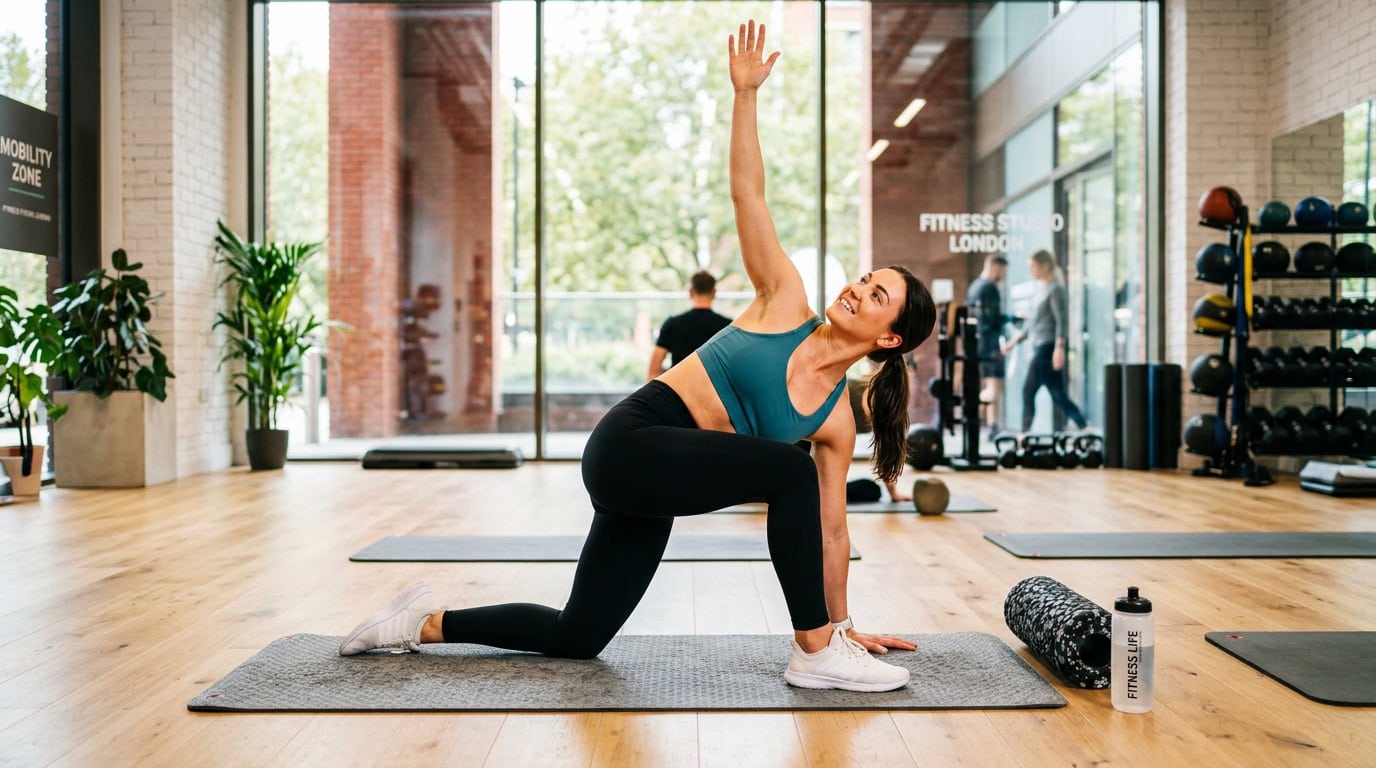
    • World’s greatest stretch: 5 per side. Lunge forward, place your elbow on the ground, rotate your arm to the sky. A full-body opener in one movement.
    • Bodyweight squats: 10 reps, focusing on depth and pushing knees out. If your heels lift, place a small plate under them.
    • Ankle circles: 10 per direction per ankle. Often overlooked but critical for squat depth.

    Upper Body Focus

    • Arm circles: 15 forward, 15 backward. Gradually increase the size.
    • Band pull-aparts: 15 reps with a light resistance band. Great for posture and shoulder health.
    • Cat-cow stretches: 10 reps on all fours. Mobilises the entire spine.
    • Thread the needle: 8 per side. From all fours, reach one arm under your body and rotate your torso. Excellent for thoracic rotation.

    After Your Workout: Static Stretching Routine (10-15 Minutes)

    Post-workout is when static stretching shines. Your muscles are warm, making them more receptive to lengthening. Hold each stretch for 30-60 seconds, breathing deeply:

    Essential Stretches for Gym-Goers

    • Standing hamstring stretch: Place one foot on a bench, hinge at the hips with a flat back. Feel the stretch in the back of your thigh, not your lower back.
    • Pigeon stretch: From all fours, bring one knee forward to the same-side wrist and extend the other leg back. Opens the hip flexors and glutes — essential for anyone who sits at a desk.
    • Wall pec stretch: Place your forearm on a wall at 90 degrees and turn your body away. Targets the chest and anterior shoulder, counteracting the hunched posture from desk work and bench pressing.
    • Couch stretch: Kneel with one knee on the floor against a wall, other foot forward in a lunge position. The single best stretch for hip flexors. Hold for 60 seconds — it’s uncomfortable, but that means it’s working.
    • Lat stretch: Grab a bar or doorframe with one hand, lean back and let your shoulder drop. Opens the lats and side of your torso.
    • Figure-four glute stretch: Lie on your back, cross one ankle over the opposite knee, and pull the bottom leg toward you. Targets the glutes and piriformis.

    Mobility Work You Can Do at Home

    You don’t need to be at the gym to improve your mobility. Here’s a simple 15-minute routine you can do in your living room, ideally on rest days or in the evening:

    1. Deep squat hold: 60 seconds. Use a doorframe for balance if needed. Push your knees out and keep your chest up.
    2. 90/90 hip switches: 10 switches. Sit with both knees bent at 90 degrees, then switch sides by lifting your legs and rotating.
    3. Thoracic spine foam rolling: 2 minutes. Lie on a foam roller across your mid-back, support your head, and extend over the roller.
    4. Shoulder dislocates: 15 reps with a broomstick or resistance band. Hold it wide, slowly bring it from in front of your body to behind and back.
    5. Ankle dorsiflexion stretch: 60 seconds per side. Kneel with one foot flat against a wall, knee touching the wall, and lean forward.

    Common Mistakes to Avoid

    • Bouncing during stretches: This triggers the stretch reflex, which actually makes the muscle tighter. Hold still and breathe.
    • Stretching cold muscles: Always do some light movement (even a brisk walk) before static stretching.
    • Ignoring pain: Stretching should feel like mild discomfort, not pain. Sharp or shooting pain means you’re going too far or there’s an existing issue that needs attention.
    • Only stretching the muscles you trained: If you sit at a desk all day, your hip flexors, chest, and hamstrings are probably tight regardless of what you trained. Address your posture-related tightness every session.
    • Doing it once and giving up: Like strength training, mobility requires consistency. Five minutes daily is far better than 30 minutes once a week.

    How Long Until You Notice a Difference?

    Most people notice improved range of motion within 2-3 weeks of consistent daily stretching. Significant mobility improvements typically take 4-8 weeks. The key word is consistent. Ten minutes every day will get you further than an hour once a fortnight.

    Find a Gym That Supports Your Goals

    The best gym for you is one that fits your lifestyle, goals, and location. Whether you’re looking for a facility with dedicated stretching zones, recovery equipment, or classes that incorporate mobility work, you can find it on GymPal. Browse thousands of UK gyms, read real reviews, and compare facilities to find the right fit for your training journey.