Walk into most UK gyms and the rowing machines are tucked in the corner, usually gathering dust while the treadmills and bike racks have a queue. That’s starting to change. Indoor rowing is having a genuine moment, helped along by HYROX’s explosion in popularity and Birmingham gearing up to host the World Rowing Indoor Championships in December 2026 — the first time Great Britain has staged the event.
The appeal makes sense once you try it properly. A rowing machine works your legs, back, core and arms in a single fluid movement, it’s low-impact enough for bad knees, and a focused 20-minute session can torch more calories than most people expect from a “cardio machine in the corner.” The catch is that almost nobody is taught to use one properly, which is exactly why so many people give it one awkward go and never come back.
This guide covers proper rowing technique, a beginner-friendly first workout, how to build up intensity without wrecking your lower back, and why so many UK gym-goers are suddenly fighting over the one working rower in the weights room.
Why the Rowing Machine Deserves a Second Look
Rowing is one of the only pieces of gym kit that trains almost your entire body at once — roughly 85% of your muscle mass is involved in a full stroke, from your quads and glutes through your back, shoulders and core. That full-body recruitment is why a rower can rival running for calorie burn while putting a fraction of the impact through your joints, which makes it a solid option if you’re carrying an old injury or simply hate the way treadmills feel on your knees.
It’s also quietly become one of the most under-used pieces of equipment in British gyms. Research from British Rowing found a vast untapped market for indoor rowing, with around 13 million people in Britain having tried an indoor rower but only a fraction of gym-goers using one regularly. In other words: the machine is sitting right there, most people just haven’t been shown what to do with it.
On the numbers, 30 minutes of moderate rowing burns somewhere in the region of 210 to 300 calories depending on your weight and effort level, rising well past 400 if you push the pace. A steady 20 to 30-minute session several times a week also goes a long way towards the 150 minutes of moderate-intensity activity adults in the UK are generally advised to aim for each week, and because the movement is seated and low-impact, it’s far kinder to ageing knees and hips than pounding out the same time on a treadmill.
Types of Rowing Machine You’ll Find in UK Gyms
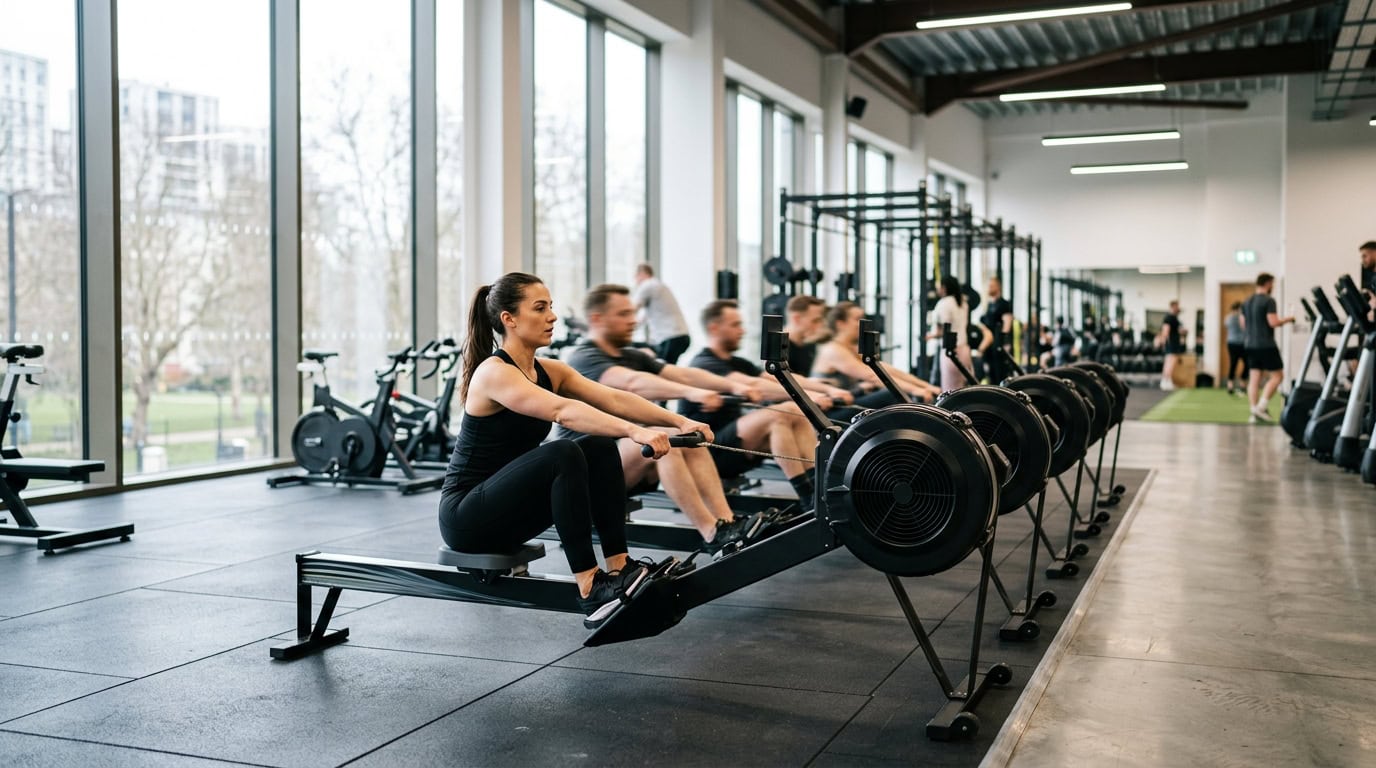
Not all rowers feel the same, and knowing the difference saves you turning up expecting one feel and getting another. Most commercial UK gyms use air resistance machines (Concept2’s Model D and RowErg are the industry standard — you’ll recognise the flywheel and whooshing sound), where resistance scales with how hard you pull rather than a fixed dial. Magnetic rowers are quieter and give a smoother, more consistent resistance, which some beginners find easier to settle into. Water rowers, with their enclosed paddle tank, are less common in gyms but give the closest feel to rowing on actual water, along with a satisfying sloshing sound that fans swear by.
None of this matters much for your first few sessions — the technique is identical across all three — but it’s worth knowing so a “damper setting” on an air rower (which changes how the flywheel feels, not how hard the session is) doesn’t throw you off if you’re used to a gym with magnetic machines instead.
Getting Your Technique Right Before You Pull Hard
The single biggest reason people write off rowing machines is bad form — specifically, yanking with the arms and back before the legs have done any work. Fix the sequence and the whole movement suddenly feels smooth instead of exhausting after 90 seconds.
Think of each stroke in four parts:
- The catch: knees bent, shins vertical, arms straight, body leaning slightly forward from the hips.
- The drive: push through your heels first, legs doing most of the work, then lean back slightly from the hips, and only then bend your arms to pull the handle to your lower ribs.
- The finish: legs flat, body leaning back slightly, handle held lightly against your ribs.
- The recovery: reverse the order — arms extend first, then hinge forward from the hips, then bend the knees to slide back to the catch.
The mantra rowing coaches drill into beginners is “legs, body, arms” on the drive and “arms, body, legs” on the recovery. Get that sequence right at a slow, controlled pace before you worry about speed or resistance — the damper setting (usually 3 to 5 for most beginners) controls the feel of the stroke, not how hard the workout is, so there’s no need to crank it to 10 and assume that’s harder.
A few mistakes crop up constantly on gym floors across the UK. Shooting the hips up before the arms have finished pulling — known as “shooting the slide” — robs the stroke of power and tends to leave people wondering why rowing feels harder than it should. Gripping the handle in a death-grip tightens the forearms and shoulders for no reason; a relaxed hook with the fingers is all you need. And rounding the lower back at the catch, rather than hinging from the hips with a flat back, is the single biggest cause of rowing-related back niggles. Filming yourself on your phone for ten strokes, however unglamorous, is a genuinely effective way to spot what’s going wrong.
Your First Rowing Machine Workout
If you’re nervous about looking clueless on an unfamiliar machine, you’re not alone — plenty of people who’ve worked through gym anxiety say equipment they don’t understand is the biggest trigger, more than being watched while lifting weights. The rower is actually one of the kinder places to start, because nobody’s paying attention to your split times except you.
A sensible first session looks like this:
- 5 minutes very easy rowing to find your rhythm and bed in the technique above
- 4 rounds of: 1 minute steady rowing, 1 minute rest (stand up, shake it out)
- 5 minutes easy rowing to finish, focusing purely on smoothness
That’s around 20 minutes, and it’s genuinely enough for your first few sessions. Resist the urge to check the monitor every ten seconds — glance at it every couple of minutes instead, and let your body get used to the motion before you start chasing numbers.
Building Intensity: Intervals and Beyond
Once the technique feels automatic — usually after four or five sessions — the rower becomes one of the best tools in the gym for proper interval training. Short, hard efforts with full recovery let you push much harder than steady-state cardio, and because the machine is low-impact, you can do it more often than interval running without your joints complaining.
A popular next step is 8 rounds of 250 metres hard, with 90 seconds of easy rowing between each one. It sounds short but a well-paced 250m effort hurts in all the right ways. Plenty of HIIT classes around the UK now build entire sessions around the rower precisely because it allows that short, sharp effort without the impact of sprint intervals on a treadmill.
As you get fitter, longer efforts come into play too — 500m repeats, a flat-out 2,000m time trial (the classic rowing benchmark distance), or simply holding a steady pace for 20 to 30 minutes once your aerobic base improves.
Rowing’s Big Moment: HYROX, Competitions and the UK Boom
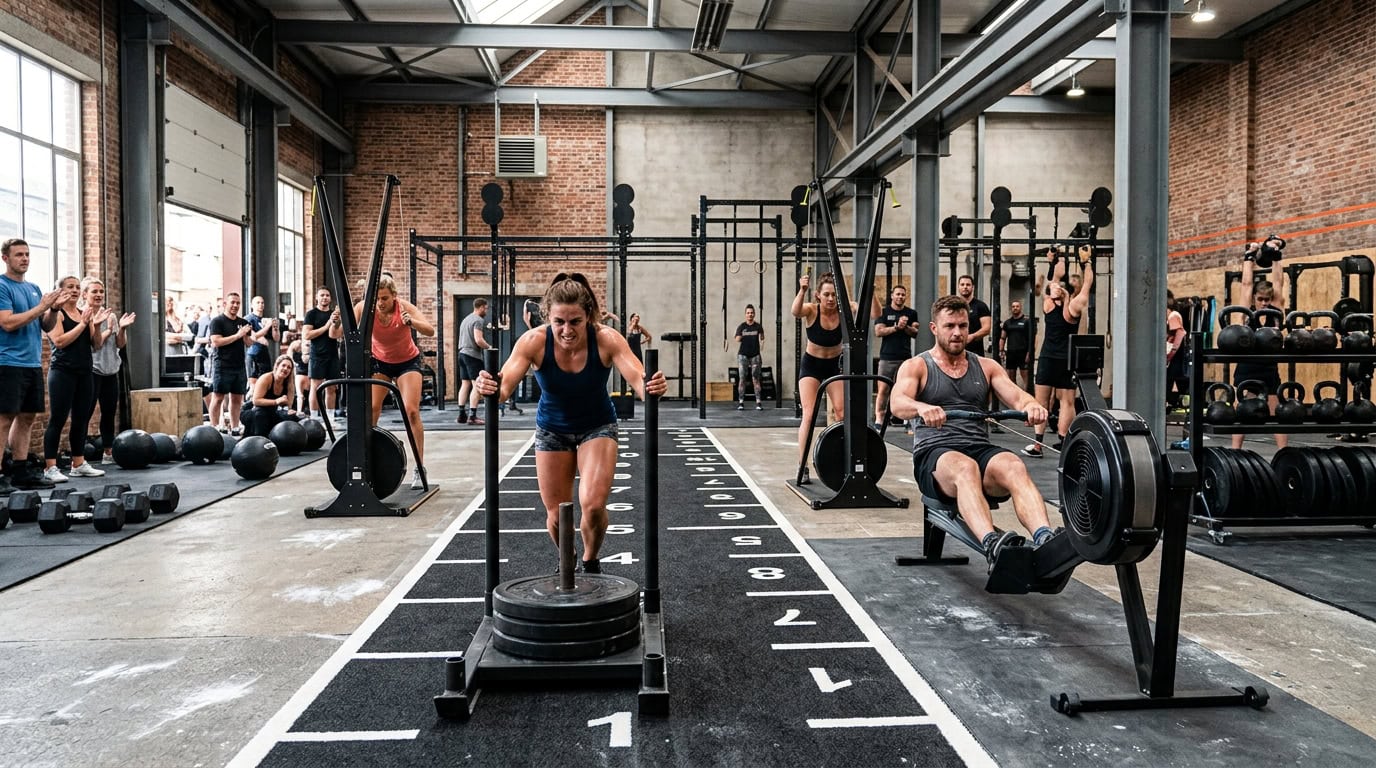
Part of why rowing machines are suddenly busy is HYROX. Anyone who’s looked into HYROX training will already know the rower is one of the eight stations in every race, usually a 1,000m row sandwiched between a run and whatever station comes next. Training for it has pulled thousands of people in the UK onto rowing machines who’d never have touched one otherwise.
There’s a competitive scene beyond HYROX too. British Rowing’s Indoor Championships have grown steadily, and Birmingham hosting the World Rowing Indoor Championships in December 2026 is expected to put indoor rowing in front of a much wider UK audience — much like what happened with parkrun and running, or CrossFit and functional fitness, once a sport got a visible, local moment in the spotlight.
Finding a Gym With Decent Rowing Machines
Not every gym treats its rowers the same way — some have one ageing machine wedged behind the squat rack, others have a proper bank of them alongside dedicated rowing-based classes. If you’re shopping around, it’s worth checking equipment lists before you commit to a contract rather than finding out on day one that the only rower is permanently “out of order.”
GymPal’s gym finder lets you filter by facilities and read what other members say about the equipment on offer, so you can find somewhere with working rowers (and room to use them) before you sign up, rather than after.
The Takeaway
The rowing machine’s reputation as a dull corner of the gym is badly out of date. Get the technique right, start with short structured sessions rather than aimless pulling, and it quickly becomes one of the most efficient, joint-friendly cardio tools available — whether you’re training for HYROX, chasing a 2,000m personal best, or just looking for twenty minutes that actually works your whole body. With indoor rowing’s profile in the UK only going one way, now’s a sensible time to stop walking past it.
Ready to find a gym with the kit to match your new rowing habit? GymPal makes it easy to compare facilities at gyms near you before you commit.

I am Adam Hall, a dedicated fitness professional with over ten years of experience in the UK’s fitness industry. I earned my Master’s degree in Sports Science from Loughborough University and have worked with several top fitness studios across the UK. My certifications include a Level 3 Personal Trainer Certificate and a specialised Strength and Conditioning Coach accreditation.
Starting my career as a personal trainer, I quickly moved up to manage multiple gym locations, overseeing their operations and training programs. Beyond managing gyms, I regularly contribute to well-known fitness magazines and have been featured in articles for “Health & Fitness” and “Men’s Health”. My passion also extends online where I run a popular blog on GymPal’s AI-powered directory platform detailing insights into choosing the right fitness venues across the UK. With hundreds of posts reaching thousands of readers monthly, my goal is to influence positive changes in how people approach health and exercise throughout the country.